The S-Curve You Are Living Inside
Why the most dangerous moment in any technological revolution is the one that looks like stability
There is a particular cruelty to the way technological revolutions end institutions. It is not that they arrive without warning. The warnings are almost always present, documented, measurable, available to anyone paying attention at the right level of time. The cruelty is that the institutions most at risk are typically the ones doing the most rigorous job of managing themselves well by the standards they have always used. They are not asleep. They are not negligent. They are optimizing, carefully and professionally, for a world that is in the process of becoming irrelevant.
This is not a story about disruption in the way that word is usually deployed in business conversation, as a synonym for a fast-moving competitor or an unexpected technology. It is a story about the structural pattern that governs how technological revolutions move through productive economies, a pattern that has been documented with remarkable consistency across the past two and a half centuries, and that produces the same institutional vulnerabilities in approximately the same sequence every time it occurs.
Understanding that pattern does not make the transition painless. But it makes it legible. And legibility, at the structural horizon, is the beginning of agency.
The economist who mapped the revolution
Carlota Perez is a Venezuelan-British economist whose work on technological revolutions and financial capital has been influential in academic and policy circles for decades and is still, in my view, underutilized in practical leadership contexts. Her central argument, developed most fully in her 2002 book Technological Revolutions and Financial Capital, is that every major technological revolution since the Industrial Revolution has followed the same structural pattern, and that pattern has two distinct phases separated by a period of financial crisis and institutional reckoning.
The first phase Perez calls the installation period. A new technological paradigm emerges — the steam engine, the railway, the electrical grid, the automobile, the internet — and financial capital floods toward it in advance of the productive infrastructure that would make it genuinely useful at scale. This is the period of frenzy: speculative investment, dramatic valuations untethered from underlying value, the sensation that everything is changing faster than anyone can track, and the emergence of entirely new economic actors who seem to be operating by different rules than the institutions that preceded them. The installation period ends, consistently, in a financial crash. The speculative excess collapses. The companies that were valued on the promise of the new paradigm rather than its productive reality are repriced, often catastrophically.
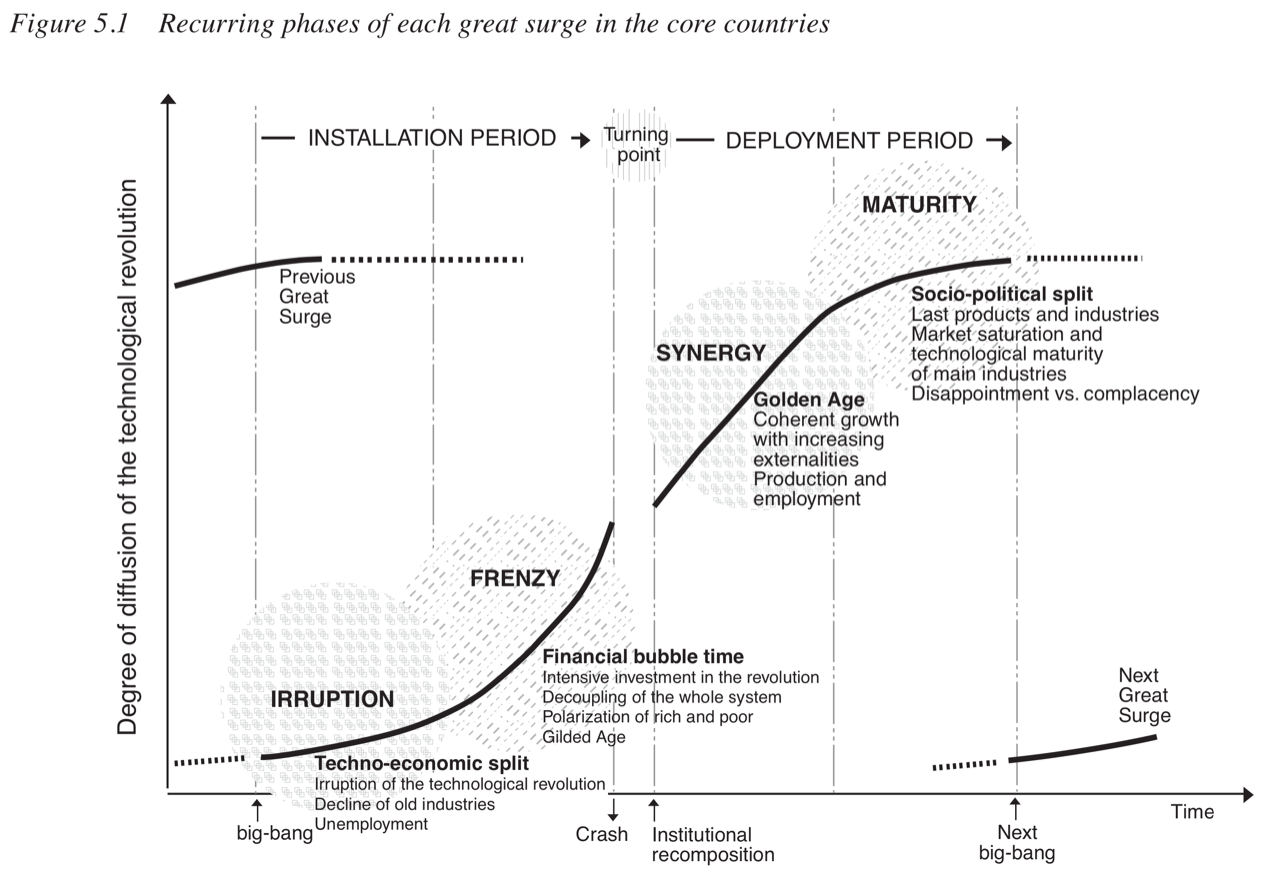
Source: Technological Revolutions and Financial Capital: The Dynamics of Bubbles and Golden Ages, Carlota Perez, 2002.
The crash feels like a failure. It is actually a clearing. What follows is what Perez calls the deployment period, the phase in which the new technological paradigm, now stripped of its speculative excess, begins to reshape the productive economy in ways that are durable rather than merely dramatic. Infrastructure is built. Standards are established. Institutions adapt, some of them, and the new paradigm becomes the common-sense foundation of economic life for the next several decades, until the next revolution begins the cycle again.
Between the installation period and the deployment period there is a turning point: a moment of institutional reckoning, regulatory reorganization, and social negotiation about the terms on which the new paradigm will be allowed to reshape economic and civic life. Perez argues that this turning point is not automatic. It requires deliberate institutional action, and whether that action arrives in time, and whether it produces a broadly shared deployment period or a more fractured one, depends on choices that are fundamentally political and social, not merely economic.
The overlap that nobody talks about
The S-curve model that emerges from Perez's work is well known in certain circles and genuinely useful as far as it goes. But the aspect of it that I find most practically important for leaders right now is something that the S-curve visualization tends to obscure, and that I want to make explicit.
The most dangerous moment in a technological revolution is not the crash. The crash is painful, but it is visible. It is dramatic. It produces an immediate institutional response, regulatory, financial, organizational, because the problem is impossible to ignore. The most dangerous moment is the overlap: the period in which the new paradigm is accelerating steadily toward dominance while the old paradigm is still structurally dominant enough that the institutions built for it are confidently optimizing for its continuation.
During the overlap, the event horizon looks relatively calm. The metrics that the old paradigm defined as indicators of health still look acceptable. Revenue is stable, or nearly so. The organization is executing its strategy competently. The competitive landscape looks recognizable. And beneath all of this, at the structural horizon, the ground is moving in a direction that will make every one of those event-level readings irrelevant within a timeframe that is visible only to anyone who knows to look for it.
This is the overlap problem, and it is not a failure of intelligence or effort. It is a structural feature of how revolutions move through economies. The institutions most vulnerable to it are often the most professionally managed, because professional management optimizes for the existing paradigm's metrics, and doing that well creates a kind of institutional confidence that makes it harder, not easier, to register the structural signals that would require a different kind of response.
The complete arc
The newspaper industry is now historically complete enough that we can see the full shape of the overlap problem without the distortion of proximity. I want to walk through it carefully, because I think it is the clearest illustration available of what the S-curve looks like from the inside of an institution living through one.
For most of the twentieth century, the newspaper was the dominant medium for local information in American civic life. It was also, for most of that period, an extraordinarily profitable business, generating advertising revenues that consistently exceeded what the editorial product alone could have commanded. The business model was not primarily about selling news. It was about aggregating a local audience and selling access to that audience to advertisers who had no other efficient way to reach it. The news was the mechanism by which the audience was assembled. The advertising was the economic foundation on which everything else rested.
The internet did not destroy this model immediately. What it did, beginning in the mid-1990s, was begin disaggregating the audience that the newspaper had spent a century assembling. Classified advertising migrated to dedicated platforms that did it more efficiently. Display advertising began finding digital alternatives that offered measurability the newspaper could not match. The audience itself began fragmenting across an expanding landscape of digital information sources. None of this was invisible. Trade publications documented it. Industry analysts measured it. The trends were available to anyone reading at the trend horizon.
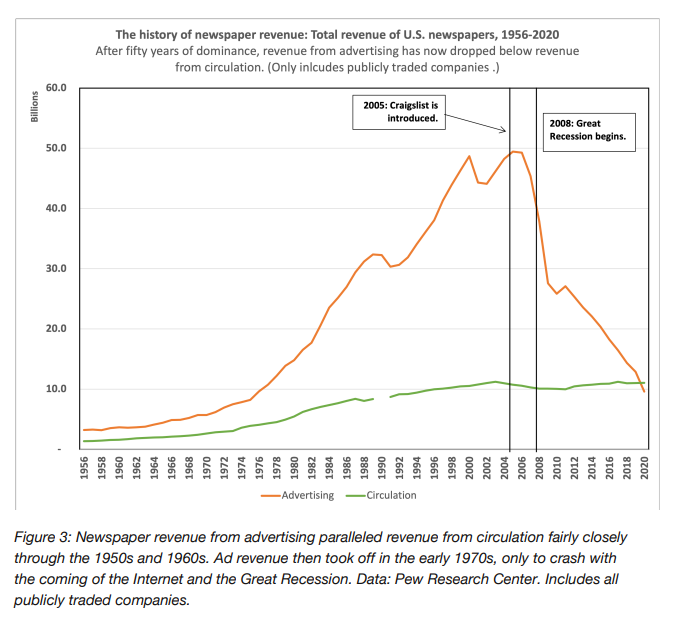
What the newspaper industry did, with considerable professional competence, was optimize the old model while the new one was developing. Costs were cut. Efficiencies were found. Circulation strategies were refined. The metrics that the industry had always used to measure health, circulation numbers, advertising revenue per page, editorial staff ratios, were tracked and managed with genuine rigor. And all of that optimization was performed in service of a model that the structural horizon had already identified as approaching its end.
By the time the overlap became undeniable at the event horizon, in the mid-2000s and accelerating sharply after 2008, the productive infrastructure of local journalism had been hollowed out in ways that proved very difficult to reverse. The institutions were not destroyed by the internet arriving suddenly. They were made fragile by a decade of confident optimization for a paradigm that was already ending, during a period when the signals of that ending were visible at the structural level and largely invisible at the event level where decisions were actually being made.
The newspaper is an extreme case, and most institutions will not follow that arc to its conclusion. But the structural logic of the overlap is not specific to journalism. It is the condition that every institution faces when a technological revolution moves through the economic paradigm on which it was built.
Where we are in the current revolution
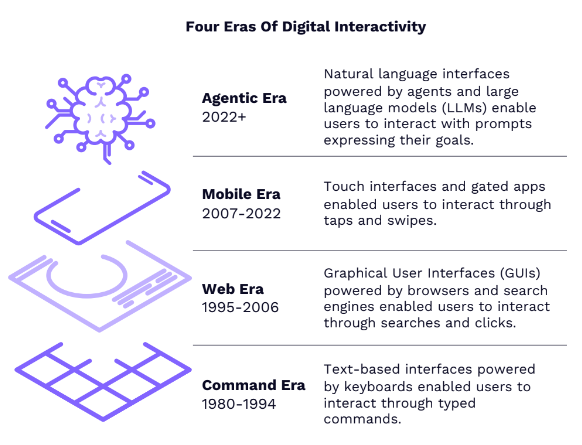
Perez's framework places the current moment at a historically specific point in the digital and AI technological revolution. The installation period for the internet economy ran from roughly the early 1990s through the dot-com crash of 2000 to 2001. The deployment period that followed established the digital economy as the dominant paradigm of the early twenty-first century, producing the platforms, the infrastructure, and the institutional adaptations that now constitute common-sense economic reality for most organizations.
What is happening now is that the digital deployment paradigm is itself approaching saturation, while a new technological revolution centered on artificial intelligence, machine learning, and advanced automation is in its own installation period. The speculative excess is visible. The dramatic valuations, the breathless pace of development, the sensation that the rules are changing faster than anyone can track, these are the signatures of an installation period in full acceleration.
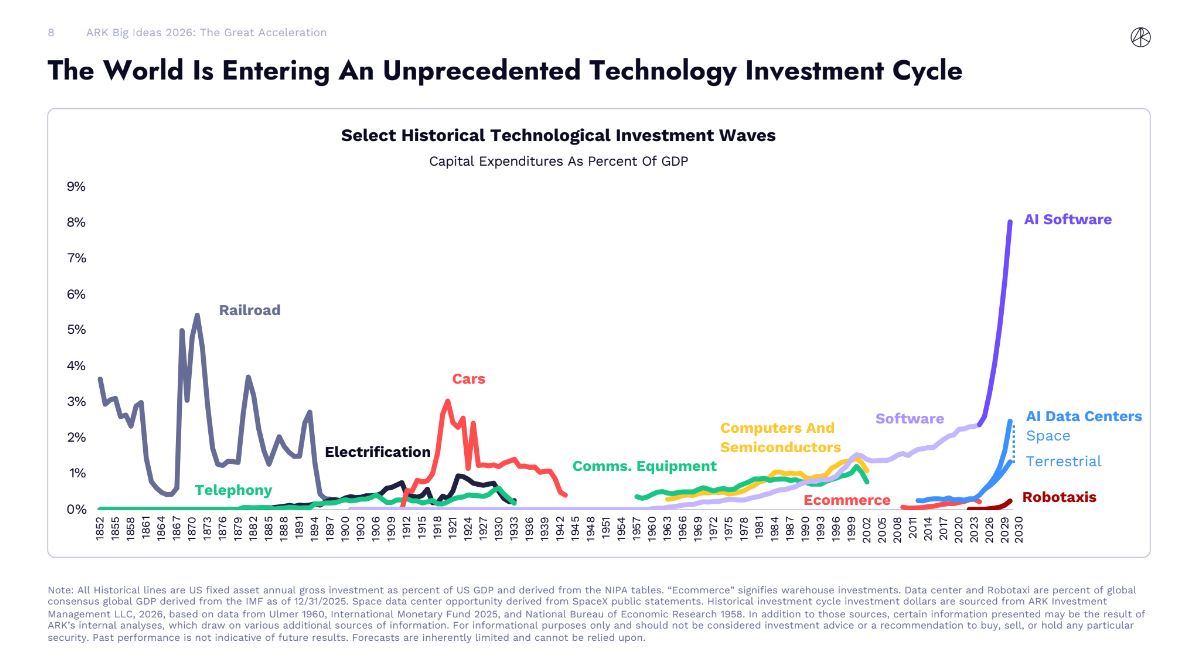
What this means for institutions is the overlap problem, again, but at a different scale and with a different set of characteristics. The institutions that optimized successfully for the digital deployment paradigm are now the ones most at risk of confident optimization for a world that is in the process of ending. The strategies, the talent models, the technology stacks, the competitive assumptions that produced genuine success in the digital economy are not automatically wrong in an AI-driven economy. But they require interrogation rather than extension, and that interrogation is only possible for leaders who are reading at the structural horizon rather than the event horizon.
Source: ARK Invest Big Ideas 2026
The question is not whether your organization has adopted the right AI tools. That is an event-horizon question, and it is not unimportant, but it is not the structural one. The structural question is whether your organization's fundamental value proposition, its reason for existing and the specific form of value it creates, remains durable as the economic paradigm shifts beneath it. Some value propositions are paradigm-independent and will translate across the transition with relatively modest adaptation. Others are so deeply embedded in the assumptions of the current paradigm that they will require fundamental reimagining rather than incremental adjustment. Knowing which situation your organization is in requires reading at a level of time that most strategic planning processes are not designed to access.
As with the generational transition, it is worth noting that the current economic wave does not press on all geographies equally. Which economies and institutions are best positioned to lead the deployment phase of the AI revolution, and which face the most acute disruption in the transition, is a question with a significant geographic and demographic dimension that the economic framework alone cannot fully answer. That dimension belongs to a later essay. For now it is enough to register that the overlap problem is universal in its logic and particular in its effects.
The discipline of reading below the surface
The Perez framework asks something difficult of leaders, and I want to name that difficulty directly rather than passing over it. It asks you to take seriously information that is not yet visible at the level where your organization's decisions are actually made. It asks you to treat structural-horizon signals as operationally relevant before they have produced event-horizon consequences, which is to say, before the urgency that typically motivates organizational response has arrived.
That is genuinely hard. Organizations are not designed to respond to slow-moving structural signals. They are designed to respond to events. The processes, the incentive structures, the meeting rhythms, the planning cycles, all of these are calibrated to the event horizon and, at best, the trend horizon. Reading at the structural horizon requires a deliberate choice to look at a layer of information that will not produce immediate vindication and may not produce any visible consequences until years after the reading was done.
But the alternative is the newspaper. Confident, professional, well-managed, and optimizing carefully for a world that had already decided to move on.
The most dangerous position in a technological revolution is not falling behind. It is leading competently in the wrong direction, with full institutional confidence, right up until the moment when the structural horizon makes itself impossible to ignore.
Next: On debt cycles, elite overproduction, and what happens when the financial architecture of an era reaches the limits of its own logic