The Pattern That Repeats Every 80 Years
What generational theory tells us about the institutions we are leading right now
In 1997, two historians published a book that made a specific and audacious claim: that American history moves through a recurring cycle of approximately 80 to 90 years, that this cycle has four distinct phases, and that the phase the country was about to enter would produce a period of institutional crisis and systemic reorganization comparable in scale to the Great Depression and World War II. The book was called The Fourth Turning. Its authors were William Strauss and Neil Howe, and their argument was not astrology or prophecy. It was pattern recognition applied to nearly four centuries of Anglo-American demographic and institutional history.
The book had a complicated cultural afterlife. It was adopted by commentators across the political spectrum who used its framework to support conclusions its authors never drew, and that association has made some readers skeptical before they have read a careful account of what the framework actually says. I want to offer that account here, because the Strauss-Howe model is among the most structurally useful lenses I have encountered for understanding why institutions behave the way they do during periods of large-scale change, and its usefulness does not depend on accepting any particular political reading of it. It depends only on taking seriously the idea that human generations leave predictable fingerprints on the institutions they build, maintain, and eventually fail to hold together.
What the cycle actually describes
The foundation of the Strauss-Howe argument is not political. It is demographic and psychological. Every generation, they observed, comes of age during a particular kind of era, and that formative experience shapes the values, assumptions, and institutional instincts that the generation carries into leadership for the rest of its life. The era makes the generation, and then the generation, when it reaches power, makes the era that will in turn shape the next generation. The cycle is self-reproducing, and it operates on a timescale roughly equivalent to a long human life.
Strauss and Howe identified four generational archetypes, each corresponding to one of four seasonal phases in the cycle. The High is a period of institutional confidence and collective solidarity, a time when the hard work of the previous crisis has produced functioning structures and a shared sense of purpose. The Awakening is the phase that follows, when a generation that grew up in that confident era begins to question its institutions on moral and cultural grounds, finding them too rigid, too conformist, too oriented toward collective order at the expense of individual meaning. The Unraveling follows the Awakening: institutions weaken, social trust erodes, individualism accelerates, and the cultural center fails to hold in the ways it once did. And then the Crisis arrives, not as a random catastrophe but as the predictable consequence of institutions that have been losing coherence for decades finally encountering a stress they can no longer absorb.
The Crisis phase is not a single event. It is a period of roughly 15 to 20 years during which the old institutional order either transforms or collapses, during which new structures are forged under pressure, and during which the generation that comes of age in the middle of it will carry the experience of that forging for the rest of their lives. Every major structural crisis in American history, the authors argued, has followed this pattern: the American Revolution and founding, the Civil War era, the Great Depression and World War II. Each arrived approximately 80 to 90 years after the last. Each produced a fundamental reorganization of the institutional order. And each was preceded by the same sequence of High, Awakening, and Unraveling that made the Crisis not just possible but, in retrospect, structurally inevitable.
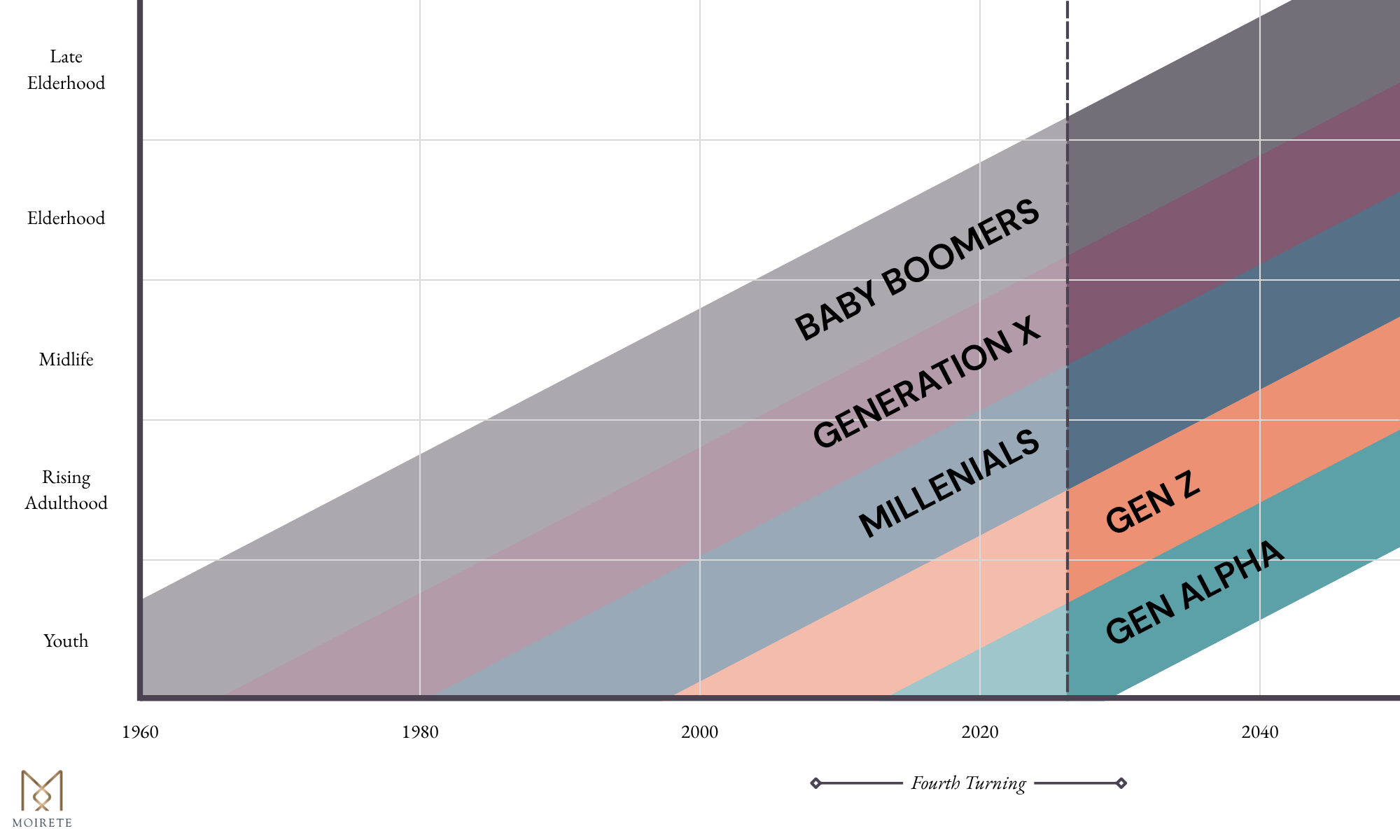
Where we are right now
Strauss and Howe placed the beginning of the current Fourth Turning around 2008, which they had anticipated years in advance as a likely trigger window. The financial crisis of that year, they argued, was not merely an economic event. It was the kind of shock that reveals structural weaknesses that have been accumulating for decades, the kind that marks a before and after in the life of institutions. In their framework, 2008 was not the cause of the current crisis period. It was the signal that the Crisis phase had begun.
Seventeen years later, it is difficult to argue that they were wrong about the timing. The institutions that were already losing coherence before 2008, financial systems, political structures, media ecosystems, educational frameworks, have continued to lose coherence at an accelerating rate. The social trust that was already eroding has eroded further. The generation now ascending to institutional leadership, the Millennials in Strauss-Howe terms, came of age watching the Unraveling and are now navigating a Crisis that many of them registered as an ambient condition of their young adulthood rather than as a departure from a stable norm. They did not experience the institutions of the High. They inherited the institutions of the Unraveling, and they are now being asked to lead those institutions through a reorganization they did not cause and did not design.
This matters practically and not just historically. A generation that did not experience the institutional confidence of the High does not have that confidence as an instinctive reference point. They cannot simply be told to trust the structures that the previous generation built, because they watched those structures produce outcomes that did not warrant trust. What they have instead, and what Strauss and Howe consistently observed in Crisis-era rising generations, is a pragmatic orientation toward building new structures rather than restoring old ones. The question they ask is not how do we get back to where we were but what actually needs to be true for this to work going forward.
That generational psychology is shaping organizational culture, talent markets, political coalitions, and institutional reform efforts simultaneously. Understanding it does not require sympathy with any particular set of conclusions the younger generation has drawn. It requires only recognizing that their institutional instincts were formed by a different experience than those of the leaders who built the organizations they are now joining and, increasingly, running.
What institutions built in one era cannot do in another
The most practically useful insight the Strauss-Howe framework offers to anyone leading an organization right now is this: institutions are built to solve the problems of the era that created them. They encode, in their structures, their incentive systems, their professional norms, and their unexamined assumptions, the conditions that made them necessary and effective. And when the era changes, the institutions do not automatically change with it. They continue, often for years or decades, to solve the problems of a world that no longer exists in the relevant ways.
This is not a failure of the people running those institutions. It is a structural feature of how institutions work. The people who built the postwar American civic infrastructure built it for a world of demographic growth, institutional trust, shared media, and relatively stable geopolitical arrangements. The people who now operate that infrastructure are running it in a world of demographic contraction in many regions, institutional skepticism, fragmented media, and geopolitical realignment. The mismatch is not a management problem. It is a temporal one. The institution is operating on a different clock than the era it is trying to serve.
The generational framework helps name that mismatch in a way that makes it possible to address rather than simply endure. When a leader understands that the difficulty their organization is experiencing is not merely tactical or even strategic but generational, meaning it is a function of which generation built the organization, which generation is now running it, and which generation it is trying to serve, they gain access to a different set of questions. Not how do we fix this program or restructure this department, but what does this institution need to become to be legible and valuable to the people whose trust it now needs to earn.
Those are harder questions, but they are the right ones. And the capacity to ask them depends on being able to read the structural horizon, which is exactly what generational theory provides.
A word about geography
The Strauss-Howe framework was developed primarily through the lens of Anglo-American history, and its predictive precision is strongest in that context. The specific configuration of this Fourth Turning, the particular institutions under stress, the specific generational psychology at play, reflects conditions that are not uniform across all geographies. Structural transitions of this kind press differently on different societies depending on their demographic composition, their institutional histories, and the physical and political constraints of their geography. That geographic dimension of the current moment is a thread this series will return to, because it turns out to be one of the most important factors in determining which institutions have the most room to adapt and which face the most acute pressure to transform.
The pattern and the present
I want to close with something that I find genuinely useful about this framework, beyond its predictive accuracy. It is this: the Crisis phase is not the end of the cycle. It is the phase that precedes a new High. Every period of institutional breakdown in the historical record that Strauss and Howe examined eventually produced a new period of institutional confidence, built on structures that were forged precisely because the old ones could no longer hold. The Revolutionary generation built a republic. The Civil War generation, after extraordinary suffering, rebuilt a union. The GI generation built the postwar institutional order that many of the organizations we are now leading were designed to serve.
The current Crisis will eventually produce its own new order. The question the generational framework cannot answer, and that no framework can answer alone, is what that order will look like and what it will require of the people leading institutions through the transition. For that, we need additional lenses. And the next one we will examine is the one that explains not the human timescale of this transition but the economic one, the structural pattern in how technological revolutions move through productive economies and what happens to the institutions that were built for the paradigm that is currently ending.
The pattern repeats. But it does not repeat identically, and the differences matter as much as the similarities. Understanding those differences is what makes the framework useful rather than merely interesting.
Next: The S-curve you are living inside, and why the most dangerous moment in any technological revolution is the one that looks like stability.
Learn More
The works below deepen the ideas in this essay and offer a mix of supportive, critical, and complementary perspectives on generational theory and institutional change.
Neil Howe, The Fourth Turning Is Here: What the Seasons of History Tell Us about How and When This Crisis Will End (New York: Atria Books, 2023). Extends the original Strauss–Howe framework into the twenty-first century and argues that the current crisis phase began around the late 2000s, providing the most recent articulation of the cyclical view this essay engages.
William Strauss and Neil Howe, The Fourth Turning: An American Prophecy (New York: Broadway Books, 1997). Introduces the 80–100 year saecular cycle and its four phases (High, Awakening, Unraveling, Crisis), arguing that each crisis period restructures American institutions for the next era.
Mark McCrindle and Ashley Fell, Generation Alpha: Understanding Our Children and Helping Them Thrive (Sydney: Hachette Australia, 2021). Uses demographic research and survey data to describe the youngest emerging cohort and the institutional context they are inheriting, illustrating a more empirical, less cyclical approach to generational analysis.
Henry Brady and Thomas Kent, “Fifty Years of Declining Confidence and Increasing Polarization in American Institutions,” Daedalus 151, no. 4 (2022): 43–61. Provides a rigorous, long-run account of how institutional confidence in the United States has eroded and polarized over five decades, offering structural context for the institutional crisis this essay describes.
Urban Institute, Understanding the Crisis in Institutional Trust (Washington, DC: Urban Institute, 2024). Synthesizes polling data and policy analysis to document declining trust across multiple U.S. institutions and connects these trends to inequality, polarization, and digital information systems, complementing generational explanations with broader structural drivers.
Bobby Duffy, The Generation Myth: Why When You’re Born Matters Less Than You Think (London: Atlantic Books, 2021). Critically examines popular generational narratives, showing where cohort effects are real and where they are overstated, and warning against treating generations as rigid, deterministic categories.
Cort Rudolph, et al., “Generations and Generational Differences: Debunking Myths in Organizational Science and Practice,” Industrial and Organizational Psychology 13, no. 3 (2020): 297–322. Reviews empirical research on generational differences at work and concludes that many widely circulated generational claims are exaggerated or methodologically weak, offering a counterweight to overly confident generational typologies.