What My Teenager Is Teaching Me About the Future of Work
A Seeing Across Time Essay
On any given Saturday afternoon, my son is in his room with his laptop and cell phone, talking to people he's never been in the same physical space with. Many of them are in other states, scattered across the U.S. Several others are sprinkled across the globe. They have a standing VC (voice call) on Discord that runs most weekends and after school on weekdays, picking up mid-conversation the way friendship often does. Most of them are GeoTubers who spend their time together building geographies in Minecraft. Elaborate ones, with political borders and alliances, contested territory, and the full texture of human conflict and repair. They also make YouTube content about it, each from their own room, in their own time zone, on their own schedule, producing things that are genuinely creative and genuinely collaborative, and that wouldn't exist without the network they've built together.
I watch this, and I don't see a kid gaming. I see the prototype of something that most corporate leadership teams can't yet build.
They're producing output without a shared location. They're maintaining accountability without a manager, though admin rights have been granted to some members to help maintain order. They're sustaining culture, navigating conflict, and generating creative work without a single standing all-hands meeting or a policy about cameras during calls. The infrastructure they're using costs almost nothing. The governance they've developed is entirely emergent. And the people doing this are teenagers.
The argument I want to make in this essay is not that the office is obsolete. It's that the logic the office was designed to enforce — uniform time, physical presence as a proxy for productivity, the manager's ability to observe the work as the fundamental unit of accountability — is a relic of a production model that most knowledge organizations left behind decades ago, and that the current wave of return-to-office mandates is the institutional equivalent of trying to run a modern power grid through infrastructure built for gaslight. The pipes are wrong. The fuel is wrong. And insisting on them isn't a management decision. It's a temporal one.
The enclosure of time
Before the factory existed, most labor was organized around tasks and seasons. You worked until the harvest was in, until the wall was built, until the thing was done. The rhythms were natural and the accountability was direct. The task was either complete or it wasn't, and the evidence was visible to everyone. Time, as a uniform and tradeable commodity belonging to someone other than the person living it, wasn't yet the dominant organizational logic of human work.
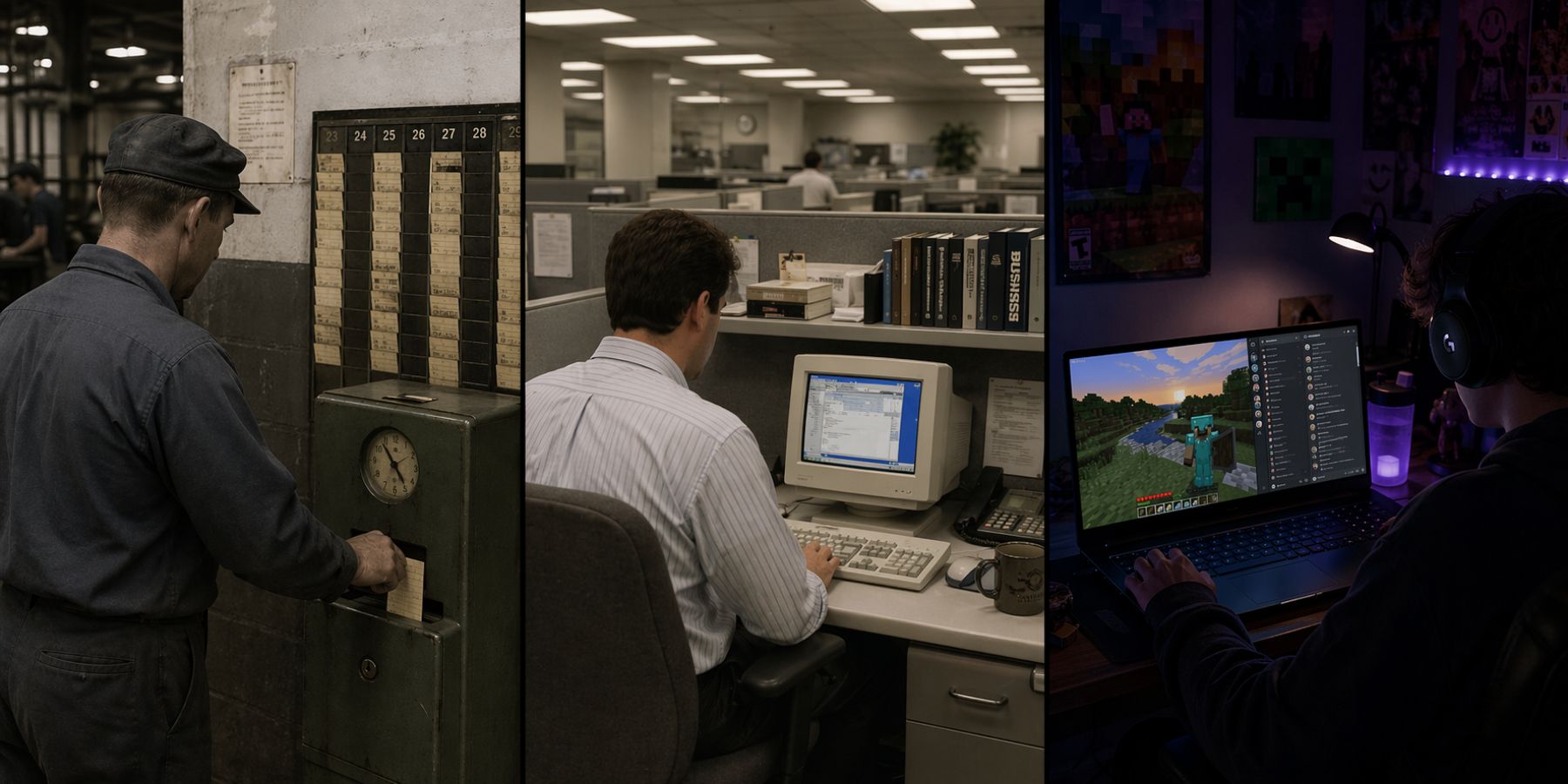
The factory changed that at the root. Moving workers into a shared physical space under a single roof wasn't only a logistical decision. It was the mechanism by which time itself was enclosed, extracted from the worker as a unit of production, and placed under the direct control of the employer. You were paid for your hours, which meant your hours belonged to the person paying for them, which meant that being present and visible during those hours was both the product and the proof of the transaction. Management, in this model, was fundamentally the supervision of time. The foreman walked the floor. The clock punched workers in and out. Shared presence was integral to the work.
This is the origin of the 9-to-5, and it's not a neutral scheduling convention. It's the residue of an original enclosure that's been normalized across so many generations that it now presents as common sense. The factory didn't discover the optimal unit of human productivity. It invented a system for controlling the conditions under which productivity could be extracted, and it designed every management practice downstream of it to reinforce and perpetuate that control.
The 8-hour day and the 5-day week weren't gifts from enlightened employers. They were won against fierce institutional resistance, on the grounds that productivity would collapse, that workers couldn't be trusted with unstructured time, and that the economy would suffer. Henry Ford's decision in 1926 to adopt the 40-hour work week was notable precisely because he justified it on output grounds, which was an acknowledgment, however reluctant, that the relationship between hours and production wasn't linear. That acknowledgment has been available for a century. Most management philosophy has declined to follow it to its conclusion.
The modern factory makes this argument undeniable. The production floor that gave the 9-to-5 its original logic has been transformed beyond recognition. It's now a large integrated system, layered with IoT sensors, AI analytics platforms, and automated equipment that calibrates itself in real time. The human worker on that floor is no longer the unit of production whose presence and pace determine output. The machine is. And the machine isn't punching a clock. Production data generated by a modern manufacturing line is granular to a degree that no floor manager walking the aisles ever approached. Output, quality, deviation, efficiency — all of it is measured continuously, automatically, and without requiring anyone to observe a human being doing the work.
The factory that invented the 9-to-5 no longer needs it. The office that inherited it hasn't noticed.
What is actually being defended
The return-to-office argument is increasingly made on cultural and control grounds rather than productivity grounds, in part because large-scale studies have failed to show a consistent productivity advantage for fully in-office mandates. Multiple reviews over the past several years have found that hybrid arrangements deliver output at least comparable to that of traditional office work, with lower turnover and stronger employee well-being. McKinsey's 2025 analysis found no clear productivity winner among remote, hybrid, and fully in-person employees, and Owl Labs' 2025 State of Hybrid Work report found that 69% of managers believe hybrid and remote work have made their teams more productive. Gallup's research consistently links flexibility and reduced commuting burden to lower burnout and stronger engagement, while mandatory 5-day in-office requirements correlate with higher disengagement and lower well-being. The evidence doesn't make a convincing case for blanket in-office mandates, at least not on productivity grounds.
What's actually being defended is something older and harder to name. It's the manager's ability to observe the work. Not to measure it, not to evaluate it, not to hold it accountable to outcomes. To see it happening. The office, for the generation of leaders who currently insist on its return, isn't primarily a collaborative infrastructure. It's a supervision infrastructure. And the deepest resistance to dismantling it isn't operational. It's existential. If you can't observe someone working, you can't perform the act of managing them in the way you were trained to perform it, in the way your own career was evaluated and rewarded, in the way you learned to read professional seriousness and commitment and potential. Remote work doesn't just change where people sit. It makes an entire management identity illegible.
This isn't a character indictment. It's a structural diagnosis. The leaders defending in-office requirements aren't unintelligent or malicious. They're operating from a mental model of what work looks like, formed inside a specific historical container, and applying that model to a moment it no longer fits. The problem isn't their values. It's their horizon.
The innovation argument
There's a more sophisticated version of the return-to-office case that deserves acknowledgment. The productivity argument has largely collapsed under the weight of its own evidence. What remains is the serendipity argument — that genuine innovation requires the unplanned collision of people in physical space, the hallway conversation that becomes a product, the lunch table exchange that reframes a problem. Steve Jobs designed the Pixar headquarters around this principle, placing the bathrooms at the building's center so that people from every department would be forced into proximity with each other. He believed that creativity came from spontaneous meetings and random discussions. JPMorgan's internal memo defending its 5-day return mandate described being together as what enhances mentoring, brainstorming, and getting things done. The serendipity argument has a lineage and genuine examples to back it up.
It's also not wrong about what it describes. Serendipitous in-person contact does produce a specific kind of generative collision. The question the argument never asks is whether physical co-location is the only architecture that produces it, or whether it's simply the architecture that the people making the argument have personally experienced and therefore take to be universal.
Serendipity is a network property, not a building property. What produces generative collision is trust, diversity of perspective, psychological safety, and the conditions under which people share ideas before those ideas are fully formed. A physical space can create those conditions. So can a well-designed distributed network, and the evidence from high-performing remote and hybrid teams suggests that when those conditions are built intentionally rather than left to the accident of proximity, the results are equivalent or better. The serendipity argument is actually an argument for trust architecture. The office is one delivery mechanism for that architecture, and for a globally distributed workforce operating across time zones and disciplines, it's not the most efficient one.
What the serendipity argument reveals, when examined closely, is the same thing the productivity argument reveals — an assumption that the conditions for innovation are identical to the conditions of control. Jobs' bathroom placement was a design intervention to engineer a specific kind of contact. The return-to-office mandate is a management intervention to engineer a specific kind of visibility. Both are attempts to solve a network problem through a physical solution. Jobs was trying to increase genuine collisions. The mandate is trying to restore observed presence. Those aren't the same goal, and they don't require the same architecture.
The horizon problem
Multi-horizon thinking asks a specific question of any given moment. Which layer of time is actually driving what you're seeing? Events have causes at the trend level. Trends have causes at the structural level. And structural patterns are themselves expressions of civilizational transitions that operate across centuries.
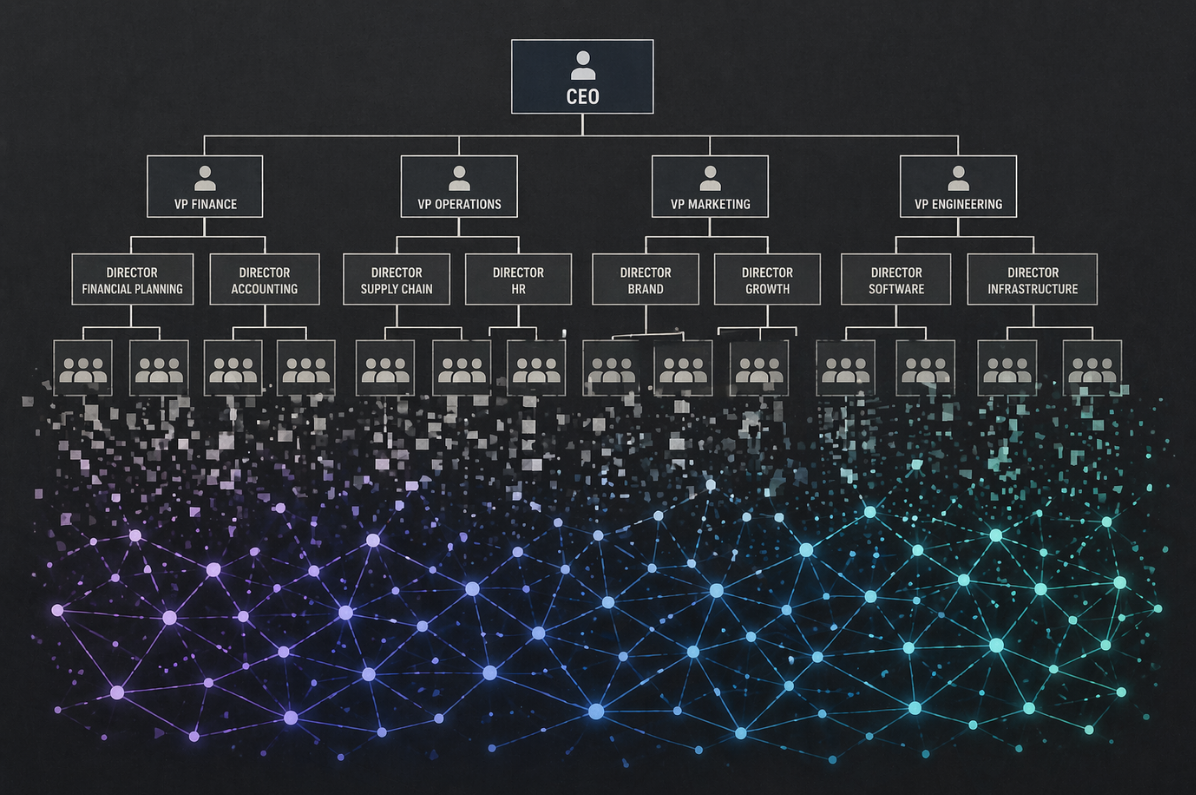
The return-to-office debate presents, at the event horizon, as a management disagreement about where employees should sit. At the trend horizon, it's one expression of a broader tension between the knowledge economy's actual operating logic and the industrial-era institutions built to govern it. At the structural level, it's a rearguard action by a command-and-control organizational architecture against the network-and-collaboration model that's replacing it — not in some future that remains to be built, but in the operational reality of every organization that's actually producing well right now.
Command and control is a coherent architecture. It was designed for a world in which information was scarce, coordination required centralized authority, and the person at the top of the hierarchy was the only node with enough visibility to make good decisions. That world no longer exists. Information isn't scarce. Coordination doesn't require centralized authority. The decisions that matter most aren't the ones that can be made from the top of a hierarchy with sufficient information. They're the ones that require distributed intelligence, rapid iteration, and the kind of trust that can only be built through genuine collaboration across a network rather than enforced through a chain of command.
Every major system undergoing transition right now is making the same structural move. Geopolitics is shifting from unipolar to multipolar, the network of powers replacing the single dominant node. Communication has already made the move, from broadcast to network, from a single authoritative signal to a distributed field of competing voices. Economic organization is following the same logic, from the vertically integrated firm that controls every node of its production chain to the platform ecosystem that orchestrates a network of distributed participants. The office debate isn't a standalone management trend. It's the workplace expression of the same underlying structural shift, and the leaders resisting it aren't resisting a policy. They're resisting the reorganization of power itself.
The generational dimension of this resistance is neither accidental nor surprising. Strauss and Howe's generational framework traces recurring cycles of institutional crisis and renewal and predicts exactly this pattern. The generations who built and inhabited the previous institutional order are the last to see its limitations, not because they lack intelligence, but because their professional identity, institutional knowledge, and accumulated advantage are concentrated in the very architecture that the transition is rendering obsolete. Seeing its obsolescence would require them to devalue everything they've built. That's not a cognitive failure. It's a structural one. Multi-horizon thinking is precisely the capacity that allows a leader to see past it — to read the structural layer rather than only the event layer, to recognize that the container and the work it holds have come apart. It's also, not coincidentally, the capacity that the leaders most invested in the current container are least motivated to develop.
The prototype is already running
My son's Discord cohort isn't a utopian vision of what work could be. It's a description of what a functional distributed network looks like when the right structural conditions are in place. There's trust, built through sustained interaction and genuine mutual investment in shared projects. There's output accountability, not to a manager but to the network itself, because the network's creative capacity depends on everyone contributing. There's asynchronous infrastructure that allows work to happen across time zones and schedules without requiring everyone to be present simultaneously. And there's culture — genuine culture, with its own norms, conflicts, repair mechanisms, and shared vocabulary.
None of these conditions required an office. All of them required intentional design, even if that design was entirely organic and bottom-up in this case. The infrastructure is Discord and Minecraft and YouTube. The governance is emergent. The accountability is to output and to each other. This isn't a metaphor for a better workplace. It's the actual operating logic of every high-performing distributed team in every sector where knowledge work is done seriously.
The research confirms what the practice already shows. Organizations whose employees have genuine schedule control report substantially higher productivity. Teams measuring output rather than hours show lower turnover, lower burnout, and equivalent or better performance across most knowledge work categories. The companies consistently ranking highest on employee performance and engagement support remote and hybrid work. The resistance to the data isn't empirical. It's architectural.
There are genuine exceptions, and they clarify rather than complicate. Childcare, critical care, emergency services, the staged sequencing of construction trades — these are cases where presence matters because the work is inherently physical or the stakes require real-time co-location that can't be replicated remotely. Presence is justified when the work itself requires it, not as a default supervision mechanism for work that doesn't. And there's a further dimension worth noting. The community resilience that matters most during flooding, fire, and infrastructure failures depends precisely on people whose time and schedules aren't entirely constrained by an employer's physical requirements. Networked, flexible people aren't a threat to community response capacity. They're its foundation.
What the systems already know
The measurement infrastructure for a networked, output-based model of work isn't a future proposition. It's being built now, at the intersection of AI, machine learning, and organizational analytics. Output can be measured with a precision that hours have never achieved. Contribution patterns within distributed networks can be tracked, evaluated, and understood at a granularity that no floor manager walking the aisles ever approached. The technical capacity to hold people accountable to genuine productivity rather than performed presence exists and is expanding rapidly.
This matters not because it offers a simple solution, but because it eliminates the last structural excuse for the hours-and-presence model. The argument that presence is necessary because output can't be measured was always a rationalization. It's now empirically false in addition to being structurally backward. The tools for measuring what people actually produce, and for understanding how distributed networks generate and sustain creative and intellectual output, are maturing faster than the management philosophies governing their deployment.
Education is tracing the same arc. When a system optimizes for the median, it serves a narrow slice of the actual distribution of learners. The growth of charter schools, magnet programs, online learning, and cohort-based models reflects the same structural reality as the distributed work movement. People learn and produce best in configurations that match their actual conditions, interests, and developmental timing, not in configurations that impose a shared container on a heterogeneous group simply because the container is administratively convenient. The classroom built for synchronized instruction and the office built for supervised presence are products of the same design logic, and they're failing in the same direction. That convergence points toward an essay of its own.
What the cycle already points toward
Every major reorganization of how human beings coordinate productive work has followed the same structural logic. A new production model emerges, the institutional containers built for the previous model resist it, the resistance holds until the cost of maintaining it exceeds the cost of reorganizing, and then the reorganization happens faster than anyone predicted and more thoroughly than anyone planned. The enclosure of time that built the factory model is completing its cycle. The evidence is everywhere — in the productivity data, in the generational preferences of the workforce now entering its most productive decades, in the operating reality of the organizations performing best right now, and in the distributed networks being built organically and without institutional permission by teenagers on Discord.
The destination isn't fully legible yet. It rarely is at this stage of a structural transition. The new architecture of work won't simply be the old architecture moved online, nor will it be the elimination of shared space and synchronous collaboration. It'll be something that hasn't yet been cleanly named, built from the structural conditions that actually enable trust, accountability, and creative output in a networked rather than hierarchical world. The cycles don't predict the exact form. They predict the direction. The move is from command-and-control to network and collaboration, from the enclosure of time to the accountability for output, from managed presence to genuine contribution.
The organizations that'll navigate this transition well aren't the ones waiting for a consensus to form. They're the ones already asking what structure the work actually requires, rather than what structure the management model finds legible. That's a different question from the one most return-to-office mandates answer.
My son already knows the answer. He just doesn't know yet that the adults are still arguing about it.
Go Deeper
McKinsey & Company. Returning to the office? Focus more on practices and less on the policy.
Owl Labs’ 9th Annual State of Hybrid Work