The Same Map, a Different Starting Point
On why the horizon you enter first changes what you see
The previous essay introduced four arcs, each originating from the same point, each spanning a different measure of time. Events. Trends. Systems. Cycles. The architecture is real, and it is always present. All four arcs are in motion simultaneously, shaping the conditions in which decisions get made.
But there is something the diagram cannot show.
The diagram presents the arcs as a sequence: innermost to outermost, smallest span to largest, days-to-months out to centuries. That ordering is intuitive, and for the purpose of introducing the model, it is useful. It implies a kind of ground-up logic — start with what just happened, then widen the lens, then widen it again.
That is one way to move through the model. It is not the only way. And depending on where you are and what you are trying to understand, it may not even be the right one.
Consider what determines where a person actually begins.
In the middle of disruption — a budget crisis, an organizational rupture, a market shock — you begin where the pressure is. Something just happened, and it requires a response. You start with the event horizon because the event horizon has already started with you. The arc you inhabit first is the smallest one, and the work of the moment is to move outward from it: to locate the event inside a trend, then inside a structural pattern, to understand not just what happened but why it was possible.
In strategic planning, the order often reverses. You begin with structure — the systems that have been operating for decades and will continue operating regardless of what happens in any given quarter. What institutional patterns constrain the options? What structural forces are nearing the end of their natural lifespan? You start from the outside and work inward, using the longer arcs to interrogate the shorter ones.
In historical interpretation — or in any moment when you are trying to understand not just what is happening but what era you are living through — you begin at the civilizational horizon and descend. What transition is the largest arc completing? What does that mean for the structural patterns beneath it, for the trends forming inside those, for the events accumulating at the surface?
Three different starting points. The same four arcs. A fundamentally different experience of what the model reveals.
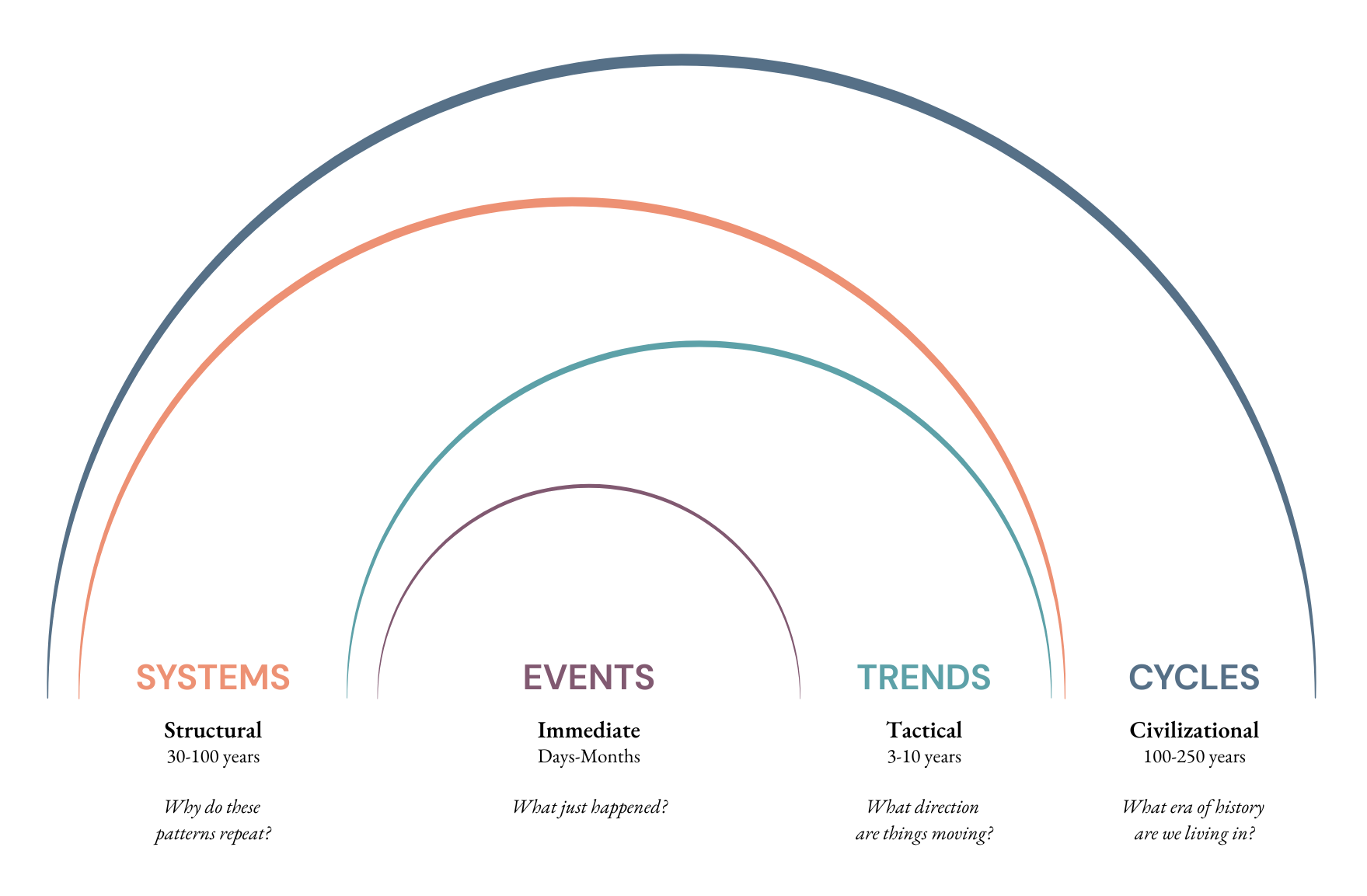
This is not a complication of the framework. It is the framework working as intended.
The four horizons are not a hierarchy in which the civilizational level is more important than the event level, or in which mastery means always beginning with the largest arc. They are interdependent layers of a single pattern. What changes is not the architecture but the angle of entry — and the angle of entry is determined by context, by role, by what the moment actually requires.
The leaders and thinkers most capable of navigating systemic transitions are not the ones who have memorized the model. They are the ones who can move through it — who can locate themselves in it, shift orientation within it, and recognize which horizon is asking for their attention and which is asking to be held in peripheral vision.
That capacity does not come from understanding the arcs. It comes from using them. From spending enough time at each horizon that you develop a feel for its texture, its tempo, its particular kind of signal.
The essays that follow begin that work. Each one enters the model from a different angle, through a different lens, looking at a different layer of what is currently in motion. The sequence is not arbitrary. But it is also not the only sequence that exists.
You will find your own.
Next: The pattern that repeats every 80 years, and what it tells us about the institutions we are leading right now.