Why Smart Leaders Keep Getting Blindsided
On what it means that systems move at different speeds
There is a particular kind of wrong that is worse than ordinary mistake-making, and most experienced leaders know exactly what it feels like. It is not the wrong that comes from bad judgment or insufficient data or a failure of process. It is the wrong that arrives after you did everything right. You gathered the information that was available. You consulted the people who should have known. You made a reasonable decision by every standard you had been trained to apply. And then the situation moved in a direction that your entire analytical framework told you it would not, and you were left trying to explain not just what happened but how you failed to see it coming.
This is the blindsiding problem. And it is worth being precise about what causes it, because the standard explanations are not quite right.
The most common explanation is speed. The world is moving faster, the argument goes, and leaders who built their instincts in a slower era are simply being outpaced by the velocity of change. There is something to this, but it is incomplete. Speed alone does not explain why intelligent, well-resourced, highly attentive leaders keep misreading situations at the structural level. Speed is a condition. Blindsiding is a pattern. Patterns have causes, and the cause of this particular pattern is not how fast things are moving. It is that different things are moving at categorically different speeds, and most leadership training has prepared people to track only one of them.
The architecture of time
Imagine standing at a fixed point and watching a series of arcs extend outward from where you are standing. The smallest arc curves close to you, spanning days and months before it returns to the ground. The next arc is larger, spanning years. The one beyond that spans decades. The largest arc of all extends so far that its curve is nearly imperceptible from where you stand, spanning generations and centuries before it completes itself.
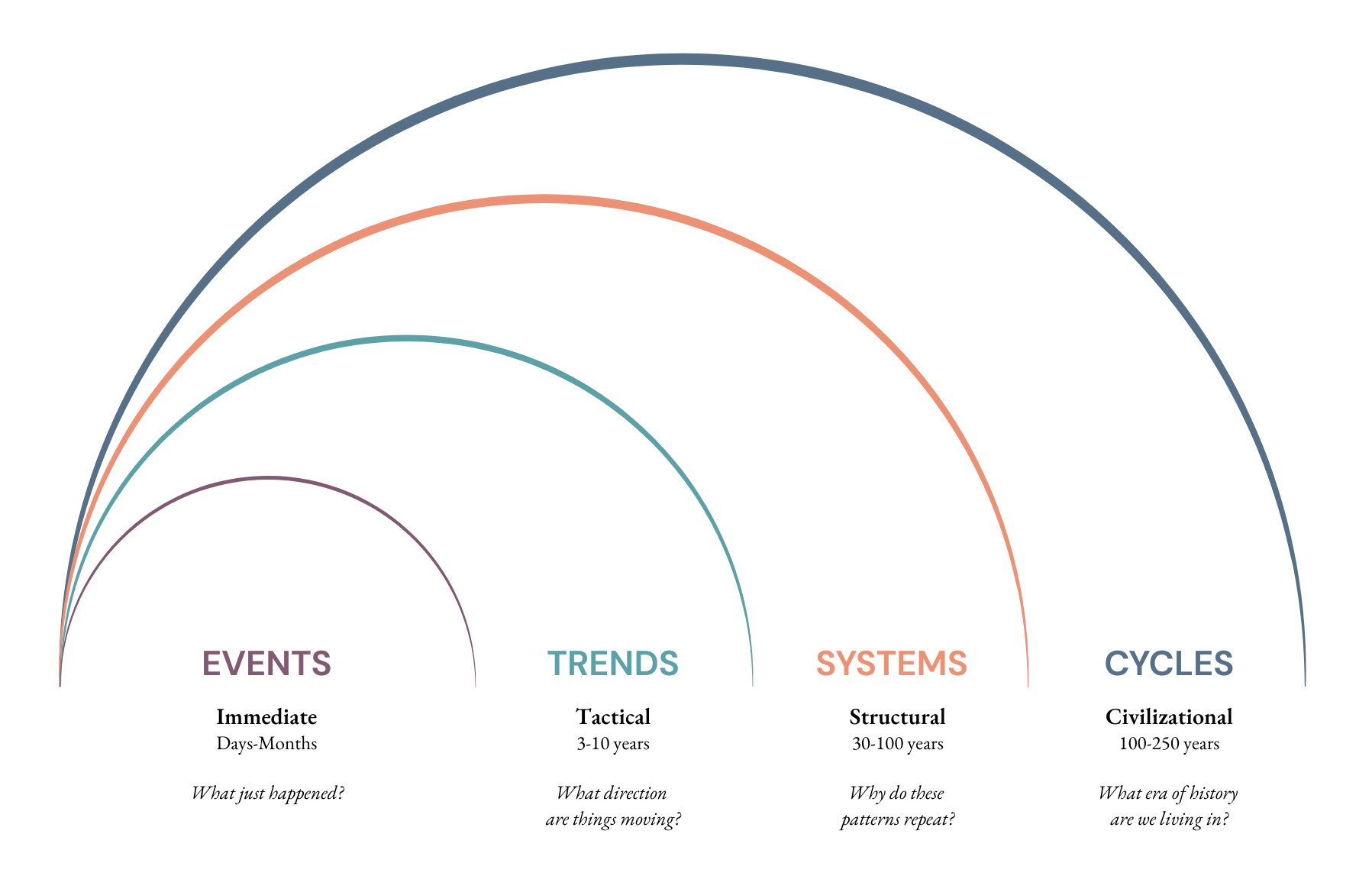
These arcs are always present simultaneously. They all originate from the same point, which is right now. And everything that is happening in the world you are trying to lead is being shaped by forces operating at every one of these scales at once.
The smallest arc, the one measured in days and months, is the horizon most leaders inhabit professionally. It is where events live. A product launch, a budget shortfall, a personnel crisis, a competitor's announcement, a regulatory change that lands on a Tuesday and requires a response by Friday. The event horizon is high noise, rapid in its emotional demands, and relentless in its claim on attention. It is also the horizon for which virtually all professional management training is designed. When something goes wrong at the event horizon, you have processes, frameworks, and colleagues who have seen something similar before. The event horizon is, in the main, navigable.
The second arc spans years, sometimes three to ten of them. This is the horizon of trends: the directional movements that are too slow to feel urgent in any single week but that are steadily reshaping the conditions in which events occur. Demographic shifts. Technology adoption curves. The slow migration of consumer behavior or workforce expectations or regulatory philosophy in one direction over another. Trends do not announce themselves the way events do. They accumulate. And leaders who are not deliberately tracking them tend to encounter them only when they have already become the new ground, at which point they feel sudden even though they were never actually sudden.
The third arc is the one that most leadership discourse treats as background rather than foreground: the horizon of systems, spanning roughly 30 to 100 years. This is the territory of generational cycles, institutional life spans, and the long wave economics of technological transformation. The questions this horizon answers are not what just happened or even what direction things are moving, but why these patterns keep repeating. Why does institutional trust erode on a predictable schedule? Why do economic paradigms have natural lifespans? Why do the same kinds of crises appear in the same kinds of configurations every few generations? The structural horizon is where those questions live, and the answers it provides are among the most stabilizing a leader can access, because they reveal that the current moment, however unprecedented it feels, has a legible structure.
The fourth arc is the largest, spanning what I will call the civilizational horizon, the scale of centuries and long historical cycles. This is not a horizon most leaders think of as operationally relevant, and in stable eras it mostly is not. But we are not in a stable era, and one of the characteristics of genuine structural transition is that the civilizational horizon becomes newly visible. When the arc that spans 100 to 250 years begins its downward curve, the effects are felt at every smaller scale simultaneously. The era we are entering is different from the era we are leaving. That is a civilizational statement, and it turns out to have immediate practical implications for anyone trying to lead an institution through the transition.
What blindsiding actually is
With this architecture in mind, the blindsiding problem becomes much easier to explain.
A leader who is reading the event horizon with great precision is seeing one arc of the full picture. They are not seeing incorrectly. They are not missing information that was available to them. They are seeing the smallest arc with considerable accuracy and missing the three arcs above it that are determining the direction and velocity of everything the smaller arc contains.
Consider what this looks like in practice. An organization notices that recruiting has become harder over the past two years. At the event horizon, this reads as a talent market problem, perhaps a compensation issue, perhaps a brand issue, perhaps a specific failure in the hiring process. Reasonable people gather data, identify the apparent causes, and implement solutions targeted at those causes. The solutions produce modest results at best, and the recruiting problem persists and deepens.
At the trend horizon, the same situation reads differently. The workforce has been undergoing a generational shift in its relationship to institutional employment, a shift that has been documented and measurable for at least a decade. The difficulty in recruiting is not a symptom of a broken hiring process. It is a symptom of a structural mismatch between what the institution is offering and what the available workforce has come to expect and require.
At the structural horizon, it reads differently still. The institutions that built their talent pipelines in the postwar era designed those pipelines for a workforce that no longer exists demographically, vocationally, or psychologically. The generation now entering peak working age grew up watching their predecessors experience the underside of institutional loyalty, and they have drawn conclusions from that experience that no amount of employer branding will overcome.
At the civilizational horizon, the situation is part of a longer pattern: the relationship between individuals and institutions is being renegotiated at a scale that happens perhaps twice in a century, and the renegotiation always runs ahead of the institutional adaptations designed to address it.
None of these horizon readings cancels the others. The event horizon still matters. Fixing a broken hiring process is still worth doing. But a leader who addresses only the event horizon will spend years treating symptoms of a cause that operates three levels above where they are looking. That is not a failure of effort. It is a failure of elevation.
The terrain underneath everything
Before I close, I want to plant a seed that this series will return to more fully later. The four horizons I have described here are patterns of time. But they do not distribute evenly across the world. The structural and civilizational forces pressing on an institution in one geography press differently on one in another, and understanding why requires a lens we have not introduced yet. Geography is not passive backdrop. It is one of the primary determinants of which institutions face the most stress during a structural transition and which have the most room to adapt. That thread belongs to a later essay. For now it is enough to note that the arc model is universal in its logic and particular in its application, and that particularity has a physical dimension that matters enormously to anyone trying to lead through a specific place and time.
Developing the skill
The capacity to read all four horizons simultaneously is not a personality trait or a natural gift. It is a learnable skill, and like most learnable skills it begins with something simpler than mastery: it begins with the habit of asking which horizon is actually driving what you are experiencing right now.
Not every situation requires all four arcs. Some genuine events are exactly what they appear to be at the event level, and responding at the event level is entirely appropriate. The skill is not in always escalating to the structural or civilizational horizon. The skill is in knowing when the escalation is necessary, which requires having enough fluency with each horizon to recognize its signature when it appears.
The leaders who navigate structural transitions most effectively share a particular quality that I have observed across many contexts and that is difficult to name precisely in ordinary language. They do not seem less stressed than their peers. They do not seem to have more information or more resources. What they seem to have is a kind of temporal orientation: a settled understanding of where in the arc of things they are standing, and a resulting ability to distinguish between the noise that must be addressed immediately and the noise that is a symptom of something operating on a much longer timescale.
That orientation is what this series is building toward. In the essays that follow, I will introduce the analytical lenses that make each horizon legible, beginning with the one that explains why the current structural transition was not only predictable but predicted, decades in advance, by researchers working from a framework most leadership development programs have never encountered.
The blindsiding problem is not a mystery. It is a consequence of reading one arc when four are in motion. And the first step toward solving it is simply learning to look up.
Next: Not everyone enters the model at the same point.