The Thread That Runs Through Everything
Why communication revolutions precede structural transitions, and why the current one is different from all the ones that came before it
There is a pattern in the historical record that is so consistent it ought to be taught as a first principle of institutional leadership, and yet it appears in almost no leadership development curriculum I have ever encountered. The pattern is this: every major structural transition in the past five centuries, every period of institutional breakdown and systemic reorganization of the kind we have been examining in this series, has been preceded or accompanied by a revolution in how information moves through society.
Not sometimes. Not in most cases. Every time.
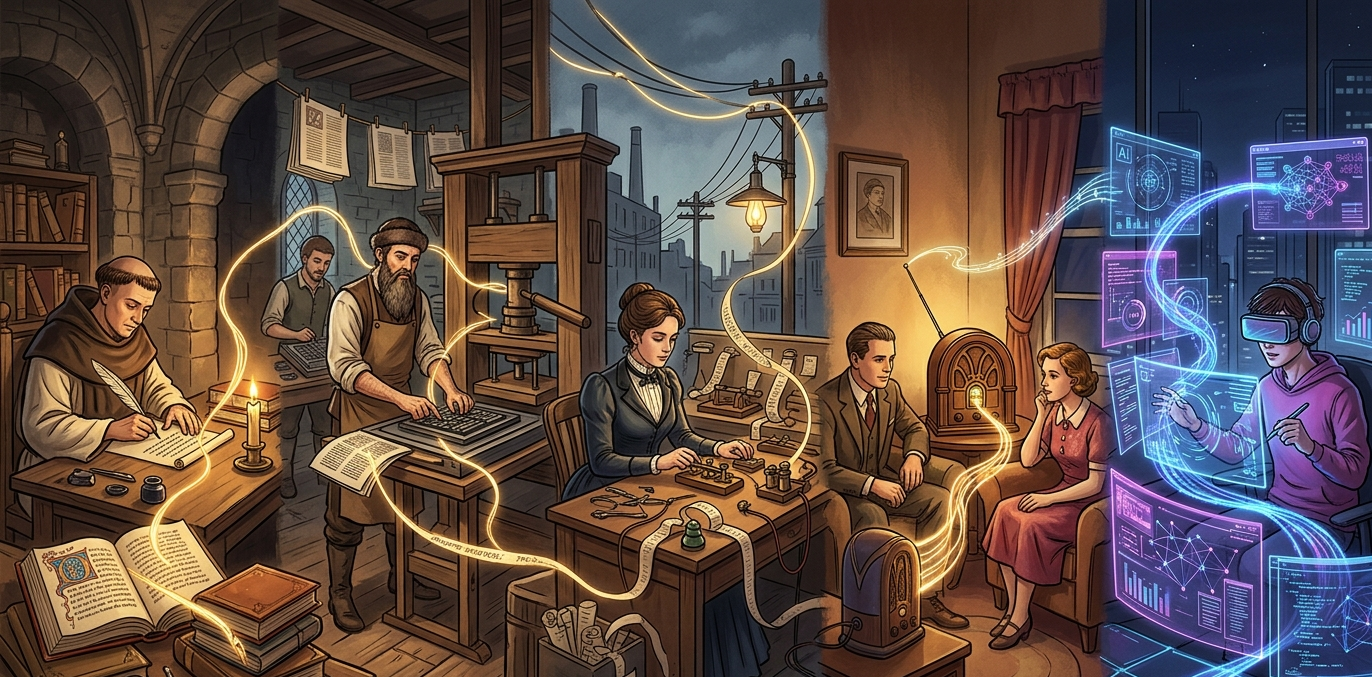
The printing press did not merely make books cheaper or more widely available. It shattered the Catholic Church's monopoly on textual interpretation, which was at that moment the primary mechanism by which institutional authority in European society was organized and legitimized. When Martin Luther posted his theses in 1517, he was doing something that would have been structurally impossible fifty years earlier, not because the ideas were unavailable but because the infrastructure for distributing them faster than the institutional response could contain them did not yet exist. The Reformation was not caused by the printing press. But it was enabled by it, and its specific character, its speed, its geographic spread, its resistance to suppression, was determined by it. The century and a half of religious and political upheaval that followed was not simply a crisis of theology. It was a crisis of information architecture.
The pattern repeated with the newspaper and the pamphlet in the revolutionary era of the late eighteenth century. The ideas of Locke and Rousseau and Paine had been circulating among educated elites for decades before they produced revolutions. What changed was not the ideas but the infrastructure for moving them. Pamphlets were cheap, portable, and impossible to fully suppress, and they carried arguments about natural rights and the illegitimacy of monarchy into communities that had never previously had access to that discourse. The American and French Revolutions were, among other things, information events: moments when the velocity of idea-distribution outpaced the ability of existing authority structures to control the narrative of their own legitimacy.
The telegraph compressed distance in ways that transformed both warfare and finance. For the first time, information could move faster than physical transportation, which meant that financial markets could operate in something approaching real time across continental distances, that military coordination could happen at a scale and speed previously impossible, and that the institutions designed for a world of slower information found themselves operating in a fundamentally different environment without having been redesigned for it. The Civil War was the first major conflict coordinated through near-instant communication, and the institutional adaptations it required, in logistics, in command structure, in the relationship between political leadership and military command, were largely improvised under pressure because no prior framework had been developed for them.
Radio made it possible, for the first time in history, for a single voice to reach millions of people simultaneously, without the friction of print distribution, without the interpretive intermediary of a reader who might encounter the text in a different context than the author intended. The political consequences were immediate and severe. Mass propaganda became possible in ways that print never enabled. The totalitarian movements of the 1930s were information phenomena as much as they were political or economic ones: they required a medium that could bypass the deliberative processes of democratic discourse and reach the emotional register of large populations directly and simultaneously. The institutions of liberal democracy were not designed for that information environment, and their struggle to adapt to it shaped the entire arc of the mid-twentieth century.
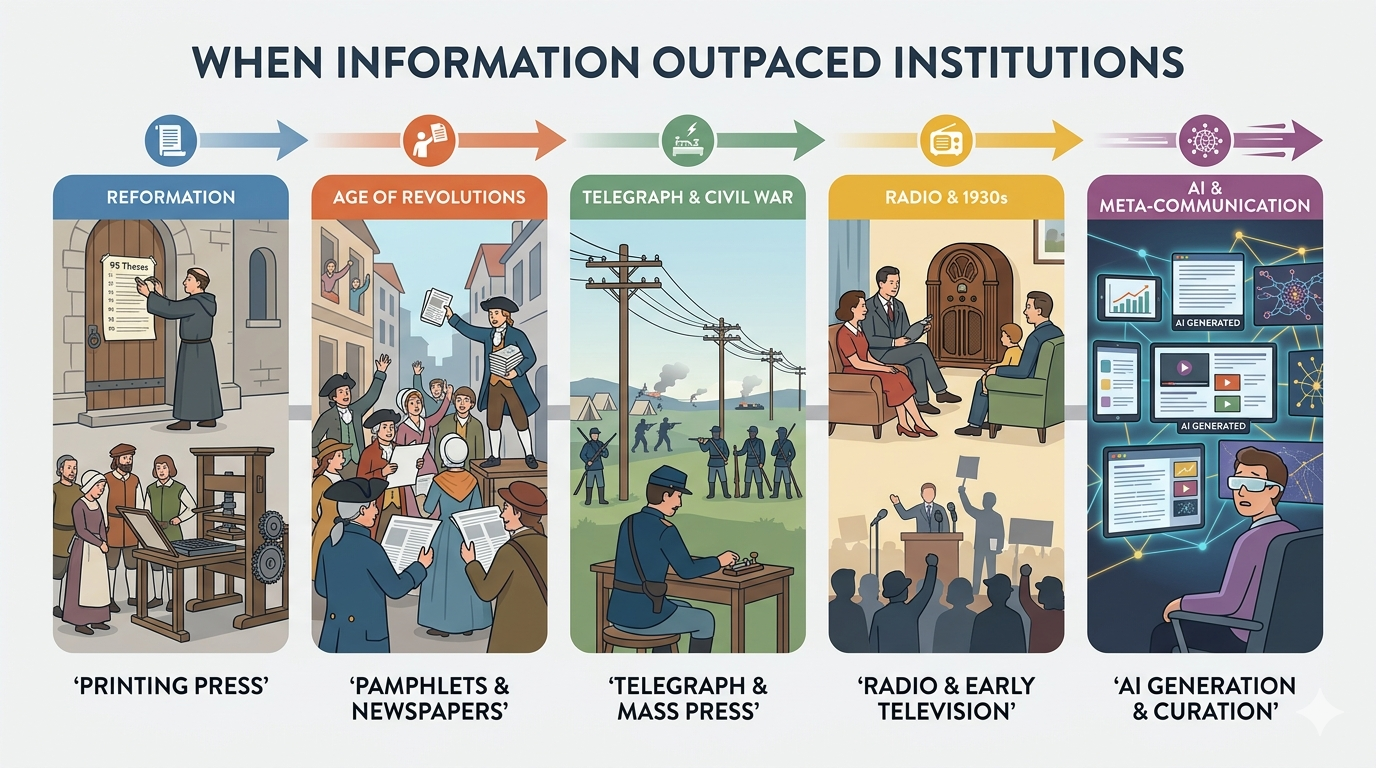
The internet extended this logic to its apparent limit, collapsing the remaining barriers of cost, distance, and institutional gatekeeping that had structured the information environment of every prior era. What took months to distribute in Luther's time, weeks in Paine's, days in the telegraph era, and hours in the broadcast era now moves in seconds, globally, without requiring any institutional intermediary between the person with something to say and the audience that might receive it. The democratization of distribution that each previous revolution had partially achieved arrived, with the internet, at something approaching completion.
What makes a communication revolution structural
The Canadian media theorist Marshall McLuhan spent his career arguing that the content of any communication medium is less important than the medium itself, that the form in which information travels reshapes the cognitive and social environment more profoundly than any particular message carried through it. His contemporary Harold Innis, less famous but in some ways more precise, argued that every dominant communication medium creates a specific kind of bias, toward either time, meaning durability and institutional continuity, or space, meaning the ability to administer large territories and coordinate distributed populations. When the dominant medium changes, the bias changes with it, and the institutions built for the previous bias become structurally misaligned with the new information environment.
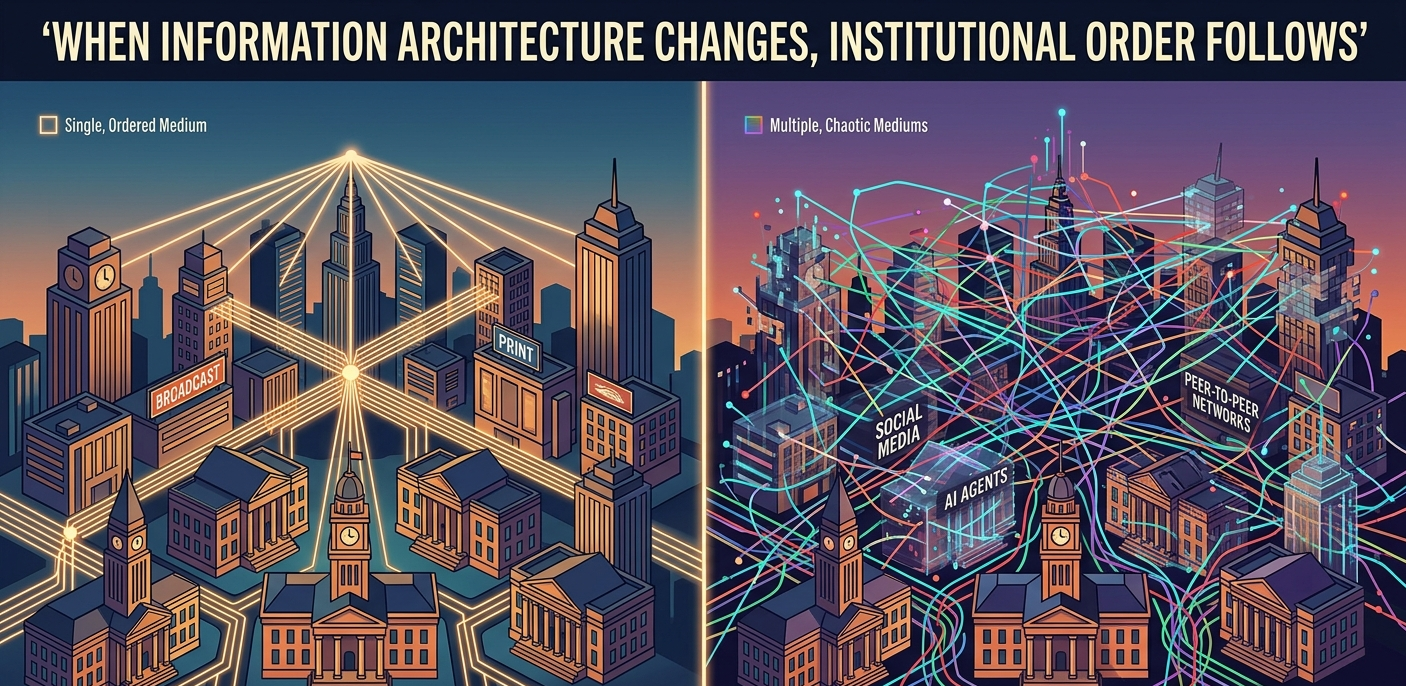
What this means practically is that communication revolutions are not primarily about new tools. They are about new power arrangements. Every time the dominant medium for moving information through society changes, the question of who controls that medium becomes newly contested, and the institutions whose authority depended on controlling the previous medium face a structural legitimacy crisis that no amount of adaptation within the old framework can fully resolve. The Church's authority was not restored by printing its own texts more efficiently. The monarchy's legitimacy was not preserved by publishing better-argued defenses of hereditary rule. The institutions designed for one information architecture cannot simply upgrade their content strategy when the architecture itself changes. They have to become different kinds of institutions, which is a much harder and slower process.
This is the lens through which the current transition needs to be understood. Not as a technology story, not as a disruption narrative in the business-school sense, but as a communication revolution with the full structural implications that phrase has carried for five centuries.
Why this one is different
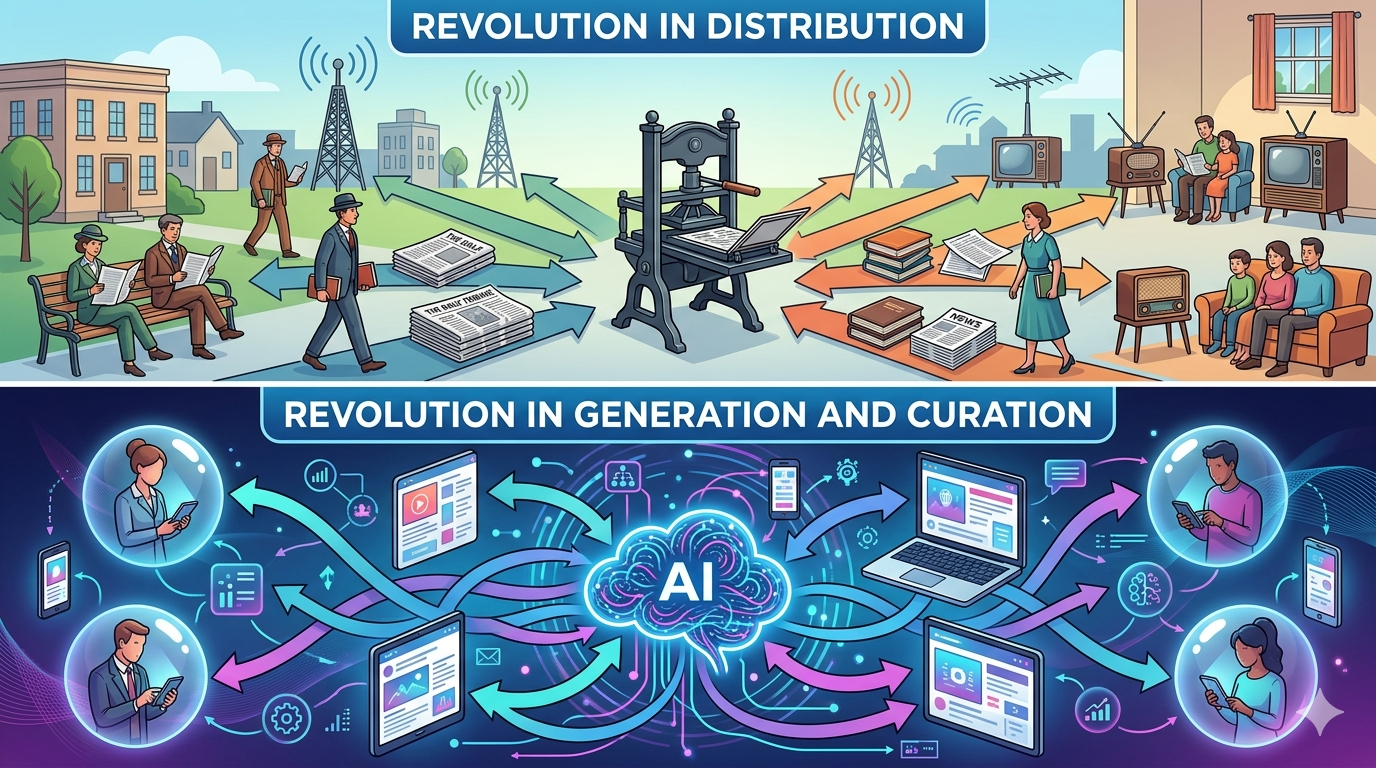
Every communication revolution in the historical record changed how information moved. Faster, further, cheaper, more widely distributed. The printing press moved text. The telegraph moved messages. Radio moved voice. Television moved image and voice together. The internet moved all of these at once and at a scale previously unimaginable. Each revolution was larger than the one before it in terms of reach and velocity, but each one was still, fundamentally, a revolution in distribution. The information being distributed was still produced, filtered, and verified by recognizable institutions: publishers, editors, broadcasters, professional journalists, credentialed experts whose authority to speak was legible within existing frameworks.
What artificial intelligence introduces is something categorically different, and I want to be precise about this because the distinction is the key to understanding why the current moment is not simply a faster or larger version of previous communication revolutions.
AI systems do not merely distribute information more efficiently. They produce it, filter it, and increasingly determine what a given individual encounters as the information environment relevant to their situation. The shift is from a revolution in distribution to a revolution in generation and curation. The information moving through the system is no longer produced primarily by humans operating within legible professional frameworks and then distributed through technological infrastructure. It is produced, assembled, and delivered by systems whose operating logic is not fully legible to the humans using them, the institutions they serve, or in many cases the engineers who built them.
This matters for institutions because the authority of most existing organizations rests on some form of epistemic credibility, which is to say, on the claim that they know something relevant and can be trusted to represent it accurately. Governments derive authority in part from their claim to legitimate information about the needs of the population they govern. Universities derive authority from their claim to produce and transmit verified knowledge. News organizations derive authority from their claim to accurately represent events. Professional associations derive authority from their claim to certify competence. All of these authority structures depend on a shared framework for distinguishing credible information from unreliable information, and that shared framework is exactly what a meta-communication revolution destabilizes.
When the infrastructure for producing and distributing information was controlled by recognizable institutions operating within established professional norms, the question of what counted as credible information was contestable but not groundless. There were referees. There were processes. There were, imperfect as they always were, structures for adjudicating epistemic disputes. When those structures lose their grip on the information environment, not because they failed but because the environment itself changed underneath them, the result is not simply more misinformation. It is a deeper crisis: a loss of shared framework for what counts as knowing something, which is the foundation on which institutional trust of every kind is built.
The thread that connects
I have been describing information shock theory in this essay as though it were a third parallel lens alongside the generational and economic frameworks introduced in earlier essays. But I want to be direct about something that the careful reader has probably already sensed: it is not a parallel lens. It is the thread that runs through all of them.
The generational crisis that Strauss and Howe documented has, in every historical instance, been accompanied by a communication revolution that amplified its speed and determined its specific character. The Fourth Turnings of American history were not merely demographic events. They were information events: the pamphlet networks of the revolutionary era, the telegraph and mass press of the Civil War period, the radio and early television of the Depression and World War II era. Each crisis was shaped by the specific form of the communication revolution that accompanied it.
The economic wave transitions that Carlota Perez documented have similarly been accompanied, in every instance, by a revolution in how information moves through productive economies. The railway revolution was inseparable from the telegraph. The electrical revolution was inseparable from the emergence of mass media. The digital revolution was, in a sense, a communication revolution that happened to have enormous productive consequences. Information infrastructure and economic infrastructure have never been separate systems, and the current AI revolution makes that inseparability more explicit than it has ever been.
The reader who has followed this series to this point now has three analytical frameworks, each developed independently, each drawing on different bodies of evidence, each asking different questions of the historical record. And all three are describing a situation with the same essential character: a moment of structural transition in which the systems that organize human life at the largest scale are simultaneously losing their previous coherence and have not yet produced the new frameworks that will eventually replace them.
There is a fourth framework this series has been gesturing toward since the first essay, one that operates not at the level of human psychology or capital or information but at the level of physical terrain and demographic reality. It is the lens that explains not why these transitions happen but where they press hardest and which institutions have the most room to adapt. The next essay introduces it directly, because understanding the geographic and structural substrate of the current moment is essential to understanding why the convergence we are examining has the specific character it does, and not merely the general character of any structural transition.
The infrastructure question
Before I close, I want to note something about the specifically geographic character of information shock theory, because it is a thread that runs into the next lens directly.
Communication revolutions do not spread uniformly. The printing press reached different parts of Europe at different speeds, and the institutional consequences varied accordingly. The telegraph followed the logic of capital and imperial infrastructure, which meant it connected some parts of the world decades before others. Radio and television were organized by national regulatory frameworks that determined who controlled access to the spectrum. The internet spread along the infrastructure of existing telecommunications networks, which meant its early geography was the geography of existing wealth and institutional capacity.
The current communication revolution is spreading along the infrastructure of AI development and digital network access, and the question of who controls that infrastructure, which nations, which corporations, which institutional frameworks, is among the most consequential geopolitical questions of the current decade. It is not a technology question. It is a power question, and it has a geographic answer. That answer is where this series turns next.
The thread that runs through everything is also the thread that leads directly into the terrain beneath it. Five centuries of evidence say that when information architecture changes, institutional order changes with it, after a period of disruption whose length and character depend on how quickly new frameworks for epistemic authority can be built. We are early in that period. The disruption has not yet produced the new frameworks. And understanding why this particular disruption is pressing where it is pressing, with the intensity it carries, requires a lens that has been present in the margins of this series since the beginning, and that is now ready to move to the center.
Next: The terrain underneath everything, and why geography is destiny in slow motion.