The Terrain Underneath Everything
Why geography is destiny in slow motion, and what it means for the institutions navigating the current transition
Every framework this series has introduced so far describes something in motion. Generations turn over on a predictable schedule, carrying the fingerprints of their formative experiences into the institutions they lead and eventually leave. Economic paradigms saturate and give way to new ones, following the structural logic of technological revolution that Carlota Perez mapped with such precision. Communication architectures transform the basis of institutional authority, breaking the epistemic frameworks of one era and forcing the construction of new ones before the transition is complete. All of these are processes. All of them move.
Geopolitics describes something different. It describes the terrain on which all of these processes play out, the physical and demographic substrate that shapes outcomes before any leader makes any decision, that constrains options leaders believe are freely available and determines others that leaders believe are chosen. Mountains do not move on any timescale relevant to institutional planning. The rivers that have served as natural boundaries for centuries serve as natural boundaries still. The chokepoints that control maritime trade, the straits and canals and deep-water ports through which the majority of global commerce has always moved, are the same chokepoints they have always been. The agricultural capacity of a river basin cannot be transformed by policy. The demographic structure of a population cannot be meaningfully altered in less than a generation.
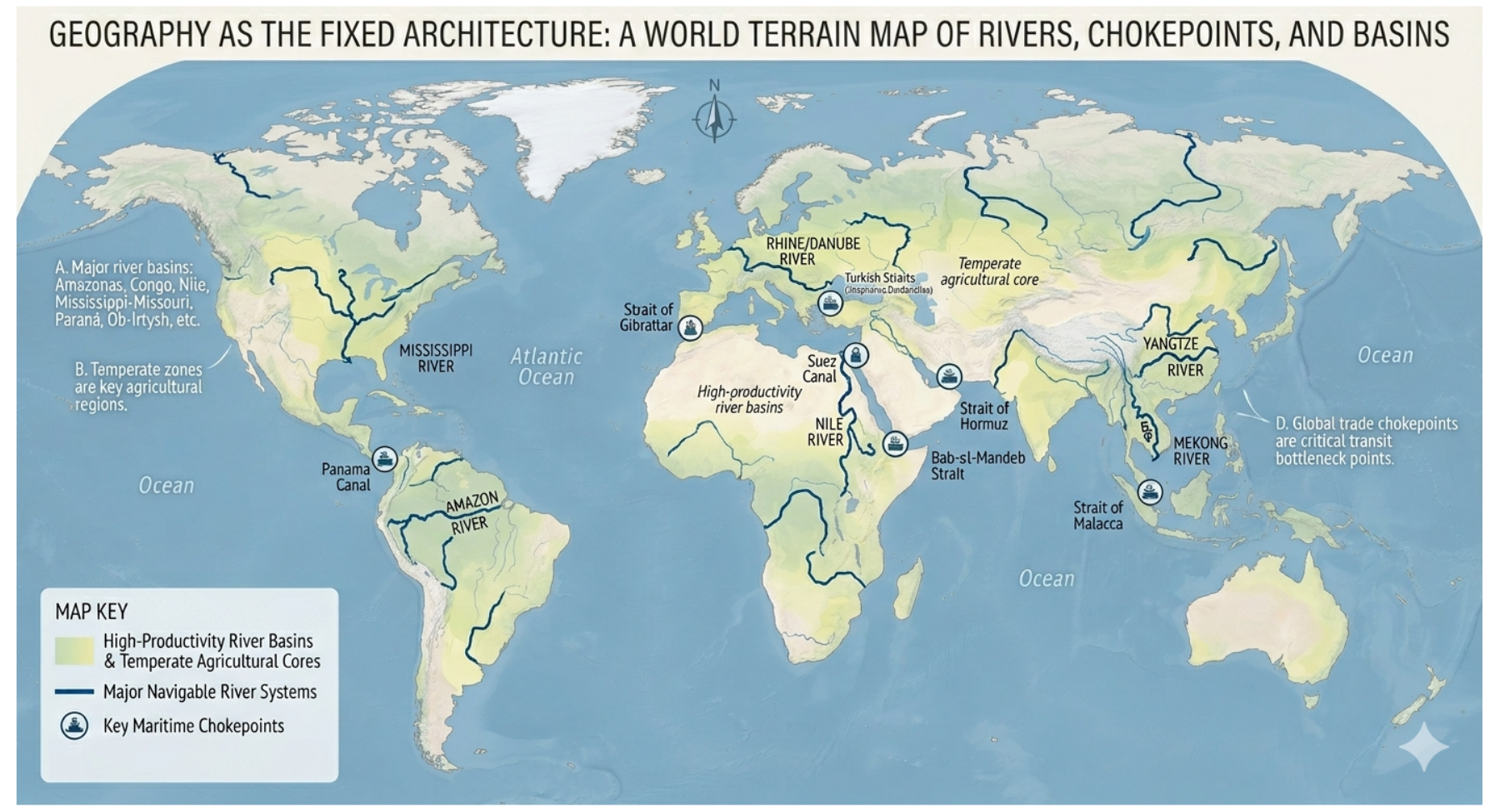
This permanence is the source of geopolitics' explanatory power and also the reason it is so poorly integrated into leadership thinking. We are trained to pay attention to what is changing, and geopolitics, at its most fundamental level, is about what does not change. It is the study of constraints so deep and so durable that they function, for all practical institutional purposes, as the fixed architecture of the world. And understanding those constraints, understanding which of them are actually determining the options available to the institutions we lead, is one of the most clarifying analytical moves a leader in the current moment can make.
The logic of physical constraint
The British journalist Tim Marshall spent years as a foreign correspondent watching political events unfold in places whose geographic realities he came to understand intimately, and the argument of his 2015 book Prisoners of Geography is deceptively simple: to understand why nations behave the way they do, you have to understand the physical terrain they occupy, because that terrain determines their vulnerabilities, their ambitions, their alliances, and their conflicts more reliably than the intentions of any particular leader or government.
Russia's foreign policy, Marshall argues, is not primarily the product of Russian ideology or Russian personality. It is the product of Russian geography. A country with no warm-water ports that are accessible year-round, with vast flat plains on its western border that have served as invasion corridors for centuries, with no natural defensive boundaries between itself and the population centers of Western Europe, will pursue control of buffer territory and access to warm water regardless of who is in power, because those imperatives are written into the physical situation rather than into any particular political program. The specific forms that pursuit takes will vary with leadership and ideology and historical moment. The underlying logic will not.
China's foreign policy is similarly legible through its geography. A country with the most productive agricultural land in Asia concentrated in its eastern river basins, with a coastline that provides maritime access but also maritime vulnerability, with land borders touching fourteen countries and including some of the most difficult terrain on earth, will organize its strategic priorities around protecting those river basins, securing that coastline, and managing those borders in ways that reflect the physical logic of its situation. The Belt and Road Initiative, whatever its specific political dimensions, follows the geographic logic of Chinese strategic interest that has been consistent for centuries.
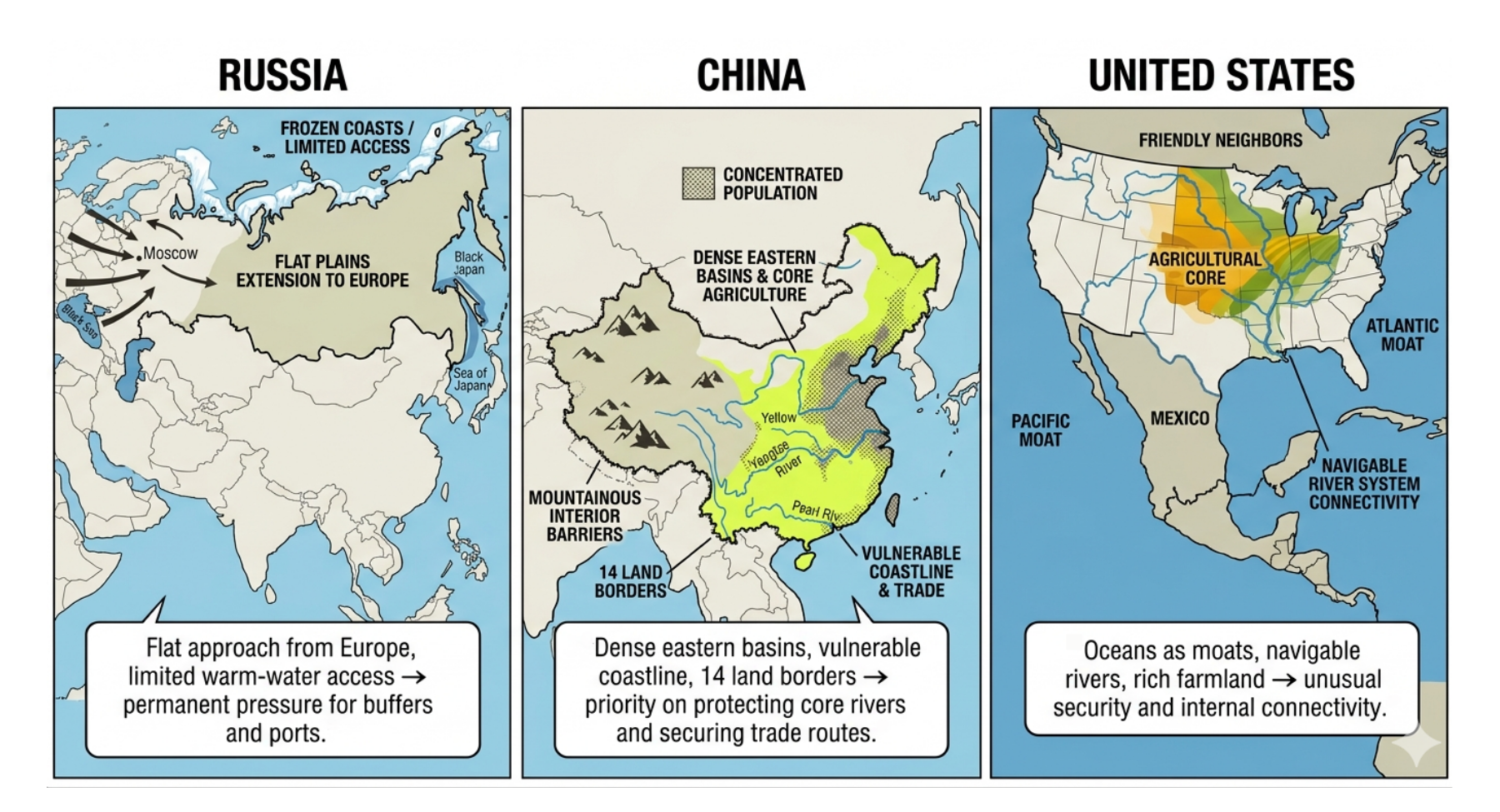
The United States, Marshall observes, occupies a geographic position of extraordinary privilege that is so familiar to Americans as to be largely invisible to them. Two vast oceans provide defensive buffers that no other major power possesses. Two friendly neighbors share its land borders. Its interior is connected by the largest network of navigable rivers in the world, providing an internal transportation infrastructure that required no deliberate construction and that has been generating economic productivity for centuries. Its agricultural land is among the most productive on earth and is positioned in a temperate zone that provides climatic stability few other regions enjoy. These are not achievements. They are inheritances, and they have shaped the specific character of American institutional development in ways that institutions in other geographic situations simply cannot replicate by adopting American institutional models.
The unwinding of a particular order
The geopolitical argument that carries the most immediate practical weight for leaders navigating the current transition comes from the American strategist Peter Zeihan, whose work on the unwinding of the postwar global order is among the most structurally clarifying analyses of the present moment I have encountered.
Zeihan's argument begins with a historical observation: the post-World War II international order, the system of alliances, trade agreements, financial institutions, and security guarantees that organized global economic activity for the better part of eight decades, was not a natural outcome of free markets or universal values. It was a specific geopolitical construction, built by the United States at a moment of unprecedented American power, and maintained because it served American strategic interests during the Cold War competition with the Soviet Union. The order that produced globalization, the integrated supply chains, the container shipping networks, the international financial architecture, the relatively open movement of goods across national borders, was underwritten by American naval power and American political will, and it was always contingent on both.
What Zeihan documents is that the strategic rationale for maintaining that order has been dissolving for decades, as the Cold War ended, as American domestic energy production transformed the country's relationship to Middle Eastern oil, and as American political culture shifted toward a less interventionist posture regardless of which party held power. The order is not being dismantled by any single decision or any particular leader. It is unwinding because the geopolitical conditions that made it rational for the United States to construct and maintain it have changed, and the physical geography of the world that will replace it looks very different from the economic geography that globalization produced.
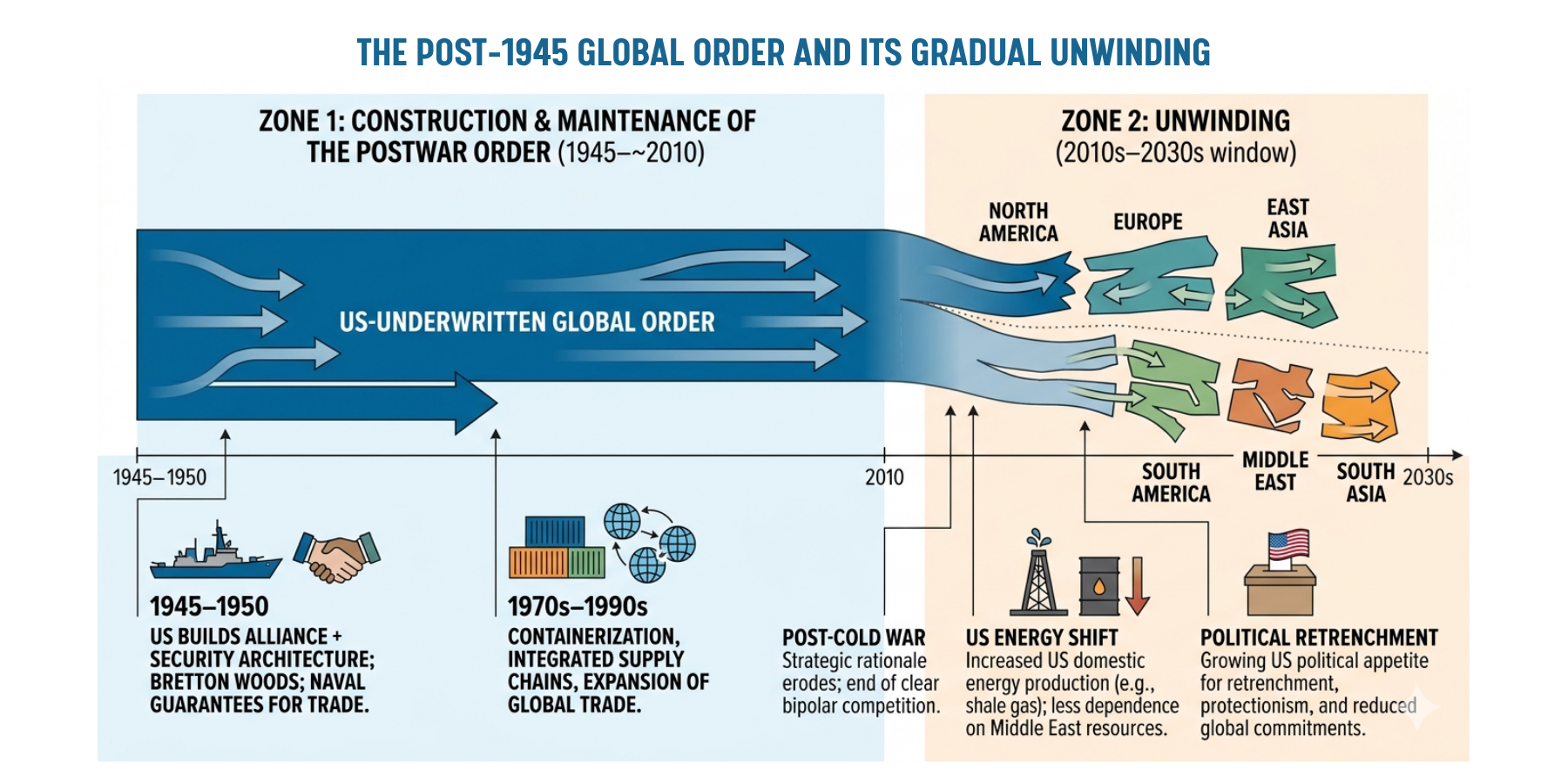
The practical implications of this unwinding for institutions are significant and underappreciated. The global supply chains that most large organizations take for granted as permanent infrastructure were assembled under specific geopolitical conditions that are no longer stable. The demographic assumptions embedded in most long-range institutional planning, assumptions about labor availability, consumer markets, and economic growth, were calibrated to a world of relatively open borders and integrated global production that is in the process of fragmenting along geopolitical lines. The financial architecture that most institutional treasury functions treat as background reality was built for a world in which American guarantees underwrote systemic stability in ways that are no longer assured.
None of this means that global trade will cease or that institutions must plan for complete autarky. It means that the geopolitical substrate of institutional planning is shifting in ways that the other lenses in this series can describe at the level of pattern but cannot fully explain at the level of specific configuration. Why are certain supply chains more vulnerable than others? Geography. Why are certain demographic trends more severe in certain economies? Geography and the history of migration and fertility that geography shapes. Why are certain communication infrastructures more contested than others? Because they follow the infrastructure of power, which follows the logic of geographic advantage and vulnerability.
Geopolitics as the substrate of everything else
I want to return now to the question that has been running through this series in the background since the first essay, because geopolitics is where it finds its clearest answer.
Why are the three transitions we have already examined, generational, economic, and communicative, happening simultaneously? And why are they producing the specific configuration of institutional stress that characterizes the current moment rather than some other configuration?
The generational transition is not geographically neutral. The specific institutions under the most acute stress are concentrated in societies with particular demographic profiles, aging populations with declining birth rates and institutional frameworks built for conditions of growth that no longer obtain. The societies that built the most confident postwar institutional orders are, in many cases, the societies whose demographics now make those institutions hardest to sustain. That is not a coincidence. It is a consequence of the specific geographic and historical conditions that shaped both the postwar High and the demographic transition that followed it.
The economic paradigm shift is not geographically neutral either. The AI and automation revolution is not distributing its productive benefits uniformly across the globe. It is concentrating them in the places that have the human capital, the infrastructure, the institutional stability, and the geographic position to lead the deployment phase of the new paradigm. The disruptions it is generating are concentrating elsewhere, in the places whose comparative advantages in the previous paradigm do not translate into the new one. Understanding which institutions are leading and which are absorbing disruption requires understanding the geographic logic of where productive capacity is actually located and what physical and demographic constraints shape its future.
The communication revolution is not geographically neutral in perhaps the most consequential way of all. The infrastructure of AI development, the data centers, the undersea cables, the semiconductor fabrication capacity, the engineering talent pipelines, is geographically concentrated in ways that are not accidental. They reflect decades of investment decisions that followed the logic of existing geographic advantage. The question of who controls that infrastructure, which I raised at the close of the previous essay, is fundamentally a geopolitical question, and the competition for that control is among the most significant structural developments of the current decade.
Geopolitics is not another thing that is changing. It is the reason the other things that are changing are changing together, in this configuration, with this distribution of stress and this distribution of opportunity. It is the terrain that all the other systems play out on, and it was always going to shape this transition in ways that the other frameworks alone cannot explain.
What this means for how you lead
The geopolitical lens asks something of a leader that none of the other lenses quite requires in the same way. It asks you to locate yourself physically, to understand the specific geographic and demographic situation of the institution you are leading and the community it serves, and to reckon with the constraints that situation imposes regardless of strategy or intention.
This is not fatalism. Zeihan is sometimes read as a determinist, as though his argument were that geography predicts everything and human agency is largely irrelevant to outcomes. That is not the argument. The argument is that geography determines the range of realistic options available and the cost of pursuing each one, and that leaders who work with the grain of their geographic situation will consistently outperform leaders who work against it, regardless of how sophisticated their strategies are in other respects.
A city in a region of demographic decline cannot strategize its way out of demographic decline. But it can make choices about which institutions to prioritize sustaining, which to allow to transform, and which to let go, that are calibrated to its actual situation rather than to a general model of institutional health developed for conditions that no longer apply locally. A supply chain built on the assumption of continued globalization cannot be simply wished into resilience. But it can be interrogated for its specific geographic vulnerabilities and adjusted accordingly, which is a very different kind of strategic exercise than generic risk management.
The geopolitical lens does not tell you what to do. It tells you what is actually true about the terrain you are operating on, so that the decisions you make are responsive to reality rather than to assumptions about reality that the current transition is in the process of invalidating.
The picture is almost complete
The reader who has followed this series to this point now has four frameworks in hand. A generational lens that explains the human timescale of institutional crisis and renewal. An economic lens that explains the capital and technological timescale of paradigm transition. A communicative lens that reveals the thread connecting every structural transition in the historical record and explains why the current one is categorically different from all the ones that came before it. And a geopolitical lens that explains the physical and demographic substrate on which all of these transitions are playing out, and why they are producing the specific configuration of stress and opportunity that characterizes this particular moment.
Four independent analytical traditions, developed by researchers working in largely separate scholarly communities, drawing on different bodies of evidence and asking different questions of the historical record. And all four are describing the same window.
That convergence deserves a name, and it has one in complexity science. But before I give it that name, I want to introduce one more lens, one that most serious analytical frameworks have declined to engage with, and that I believe belongs in this conversation precisely because it is the tradition that has been tracking convergences of this kind for the longest time. It does not predict what happens next. What it offers is something the empirical frameworks, for all their rigor and precision, cannot quite provide: a temporal map of the current window that has been refined over two thousand years of observation, and that agrees, in its own language, with everything the other four lenses have found.
The fifth lens is the oldest one. And it is the one that makes the convergence legible in a way that changes how you understand your position in time.
Next: The oldest analytical tradition and the current window, and why five independent systems pointing at the same moment is not a coincidence.